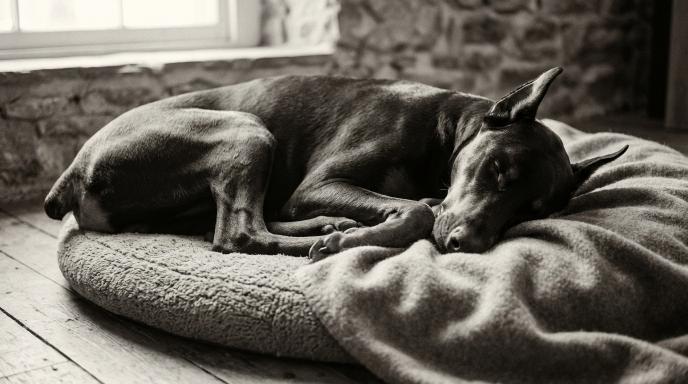
Affiliate Disclosure: Some of the links in this post are affiliate links. This means we may earn a small commission if you make a purchase through these links—at no extra cost to you. We only recommend products and tools that we genuinely believe will help you with your Doberman.
Last year, my friend Sarah called me in tears. Her 18-month-old Doberman, Duke, had destroyed her couch cushions for the third time that week. He was barking at everything, couldn’t focus during training, and seemed anxious all the time.
“I don’t know what’s wrong with him,” she said. “He’s turning into a nightmare.”
After asking a few questions, I discovered something interesting: Duke wasn’t sleeping well. Sarah had recently moved his crate away from her bedroom, and he was pacing most of the night instead of resting. Within two weeks of fixing his sleep routine, Duke’s destructive behavior disappeared.
Sound familiar?
Most Doberman owners don’t realize that many behavior problems start with poor sleep. Your dog’s rest affects everything from training success to aggression levels. If your Doberman is anxious, destructive, or hyperactive, sleep might be the missing piece of the puzzle.
In this guide, you’ll learn exactly how much sleep your Doberman needs, how sleep affects behavior, what different sleeping positions mean, and how to solve common sleep problems. Whether you’re dealing with a puppy who won’t settle or an adult with nighttime issues, you’ll find practical solutions here.
Let’s fix your Doberman’s sleep—and their behavior.
- How Much Sleep Do Dobermans Really Need?
- Understanding Doberman Sleep Cycles (The Science)
- The Sleep-Behavior Connection (Critical Section)
- Common Sleeping Positions and What They Mean
- Where Should Your Doberman Sleep?
- Common Sleep Problems & Behavioral Solutions
- How Exercise Affects Doberman Sleep and Behavior
- Environmental Factors That Improve Sleep & Behavior
- Age-Specific Sleep and Behavior Guidance
- When Sleep Problems Require Veterinary Attention
- Creating a Healthy Sleep Routine for Better Behavior
- Key Takeaways & Action Plan
How Much Sleep Do Dobermans Really Need?
Before we talk about behavior, let’s establish what “normal” sleep looks like for Dobermans.
Adult Dobermans (12-14 Hours)
A healthy adult Doberman between 1 and 7 years old needs 12 to 14 hours of sleep every day. This includes nighttime sleep plus daytime naps.
But here’s the important part: Dobermans don’t sleep like humans do. They cycle through short bursts of deep sleep (about 15 minutes) followed by light alertness (about 5 minutes). That’s why your Doberman seems to wake up the instant you walk past their bed—they’re programmed to stay alert even while resting.
This pattern comes from their protective instincts. Dobermans were bred to guard, which means their brains never fully shut off. That passing car? They heard it. That creak in the floor? They’re already evaluating whether it’s a threat.
Puppies (16-20 Hours)
Doberman puppies are sleep machines. They need 16 to 20 hours of sleep per day depending on their age:
- 8-12 weeks old: 18-20 hours
- 3-4 months old: 17-19 hours
- 5-6 months old: 15-18 hours
- 7-12 months old: 14-17 hours
If your puppy seems lazy, they’re probably not. They’re growing at an incredible rate, and that internal development requires massive amounts of sleep. Their bodies are building muscles, bones, and neural pathways while they rest.
Pregnant Dobermans (14-15 Hours)
Pregnant Dobermans need about 2-3 hours more sleep than usual, totaling around 14-15 hours daily. They’re literally building new life inside them, which is exhausting work. You’ll notice your pregnant Doberman seeking out quiet spots for extra naps as her pregnancy progresses.
Senior Dobermans (17-20 Hours)
Older Dobermans (7+ years) sleep 17 to 20 hours per day. Their bodies take longer to recover from activity, and age-related issues like arthritis make rest more necessary. This increase in sleep is completely normal and healthy.
Active vs. Less Active Dobermans
Here’s where individual differences matter. A Doberman who does agility training, goes on long runs, or works as a protection dog needs about 2 extra hours of sleep—roughly 14-16 hours total. Their bodies require more recovery time.
| Life Stage | Sleep Hours/Day | Notes |
|---|---|---|
| Puppy (8-12 weeks) | 18-20 hours | Rapid growth requires maximum rest |
| Puppy (3-6 months) | 16-19 hours | Still developing, high sleep needs |
| Puppy (7-12 months) | 14-17 hours | Transitioning to adult patterns |
| Adult (1-7 years) | 12-14 hours | Standard for healthy adults |
| Active Adult | 14-16 hours | Extra recovery from intense activity |
| Pregnant | 14-15 hours | Supporting developing puppies |
| Senior (7+ years) | 17-20 hours | Increased need due to aging |
Understanding Doberman Sleep Cycles (The Science)
To understand how sleep affects behavior, you need to know how Dobermans actually sleep.
How Doberman Sleep Differs from Humans
Humans typically sleep in one long chunk—7 to 9 hours straight through the night. Dobermans are different. They’re polyphasic sleepers, meaning they sleep in multiple short periods throughout the day and night.
Think of it this way: You might sleep 8 hours straight. Your Doberman sleeps 20 minutes here, 45 minutes there, an hour at night, 30 minutes in the morning—all adding up to those 12-14 hours.
REM vs. SWS Sleep in Dobermans
Like humans, dogs experience two main types of sleep:
SWS (Short Wave Sleep): This is light sleep. Your dog’s heart rate slows, breathing becomes regular, and they’re resting but still somewhat aware. In this stage, they can wake up instantly if they hear something unusual.
REM (Rapid Eye Movement): This is deep sleep where dreaming happens. You’ll see your Doberman’s paws twitching, eyes moving under their eyelids, or even hear soft whimpers as they dream about chasing squirrels.
The difference? Dobermans reach REM sleep much faster than humans—in about 10 minutes compared to our 90 minutes. This allows them to get quality rest in shorter bursts.
Why Dobermans Wake Every 15-20 Minutes
Here’s the part most owners don’t realize: a Doberman cycles through deep sleep for about 15 minutes, then returns to light alertness for about 5 minutes.
During those 5 minutes, they’re not fully awake. They’re in a state of awareness where their protective instincts are monitoring the environment. This is why:
- Your Doberman “wakes up” when you try to sneak past them
- They hear the doorbell before you do
- They seem to sleep with “one eye open”
This pattern repeats all night long. It’s not a sleep problem—it’s how they’re built.
How Sleep Cycles Affect Daily Behavior
Because Dobermans don’t get long, uninterrupted deep sleep like humans, they need those 12-14 hours to accumulate enough REM sleep to function properly.
If your Doberman only gets 8 hours of broken sleep, they’re not getting enough deep rest. That’s when behavior problems start.
The Sleep-Behavior Connection (Critical Section)
This is where everything comes together. Your Doberman’s behavior problems might not be training issues—they might be sleep issues.
How Lack of Sleep Causes Destructive Behavior
A sleep-deprived Doberman is like a sleep-deprived toddler: cranky, impulsive, and destructive.
When dogs don’t get enough rest, their impulse control breaks down. They know they shouldn’t chew the furniture, but they lack the self-control to stop. Activities that normally wouldn’t bother them—like you leaving the room—suddenly feel unbearable.
Real-world example: A Doberman who sleeps only 9 hours instead of 12-14 might start chewing baseboards, digging at doors, or tearing up mail. These behaviors often vanish when sleep improves.
Sleep Deprivation and Aggression
This one’s serious. Lack of sleep lowers your Doberman’s threshold for aggression.
Studies show that sleep-deprived dogs are more reactive to triggers. A well-rested Doberman might ignore another dog walking by. A tired Doberman might bark aggressively or lunge at the same dog.
Why? Sleep deprivation affects the amygdala—the part of the brain that processes threats and fear responses. When your dog is exhausted, their brain perceives more things as threats.
If your Doberman has suddenly become snappy, reactive, or aggressive with other dogs or people, ask yourself: Are they getting enough quality sleep?
Hyperactivity as a Sleep Quality Issue
Here’s a paradox: overtired Dobermans become hyperactive, not sluggish.
Just like children who get wound up when they’re exhausted, Dobermans often become frantic when they need rest. They zoom around the house, can’t settle, and seem to have endless energy.
This “second wind” behavior is a stress response. Their body is flooding with cortisol (stress hormone) to keep them awake, which creates that manic energy.
How to recognize it:
- Your dog is bouncing off walls at 10 PM
- They can’t focus during training
- They seem wired despite hours of exercise
- They have trouble settling down even when tired
Solution: Enforce nap time. Put your hyperactive Doberman in their crate for a forced rest period. Within 10 minutes, they’re usually asleep—proof they needed it.
Sleep’s Impact on Training Success
Want your Doberman to learn commands faster? Make sure they’re well-rested.
Sleep is when dogs process and consolidate new information. When you teach your Doberman “down” during the day, they solidify that learning during REM sleep at night. Without adequate sleep, that consolidation doesn’t happen effectively.
Research shows:
- Well-rested dogs learn new commands 30-40% faster
- Sleep-deprived dogs struggle to retain training
- Quality sleep improves problem-solving abilities
If training isn’t working despite your best efforts, look at your dog’s sleep schedule.
Oversleeping as a Sign of Depression
While most dogs don’t get enough sleep, some sleep too much—and that’s also a problem.
If your adult Doberman is suddenly sleeping 16-18+ hours and seems lethargic when awake, depression or health issues might be the cause.
Depression in Dobermans often happens due to:
- Major life changes (moving, loss of family member)
- Lack of stimulation and purpose
- Separation anxiety becoming overwhelming
- Isolation or boredom
Dobermans are working dogs who need jobs and companionship. Without those, they can become depressed and withdraw into excessive sleep.
Separation Anxiety Rooted in Sleep Problems
Here’s a connection most owners miss: separation anxiety and sleep problems feed each other.
A Doberman with separation anxiety doesn’t sleep well when alone. Poor sleep increases anxiety. Higher anxiety makes sleep harder. The cycle continues.
Signs your Doberman’s separation anxiety is affecting sleep:
- They only sleep when you’re home
- Destructive behavior happens overnight when you sleep upstairs (they’re not actually sleeping downstairs)
- They follow you obsessively, afraid to miss anything
- They’re exhausted during the day from nighttime anxiety
Breaking this cycle requires addressing both the anxiety AND establishing healthy sleep routines.
| Behavior Problem | Possible Sleep-Related Cause | What to Check |
|---|---|---|
| Destructive chewing | Sleep deprivation (under 10 hours) | Is your dog getting 12-14 hours total? |
| Aggression/reactivity | Poor sleep quality, frequent waking | Are they able to complete full sleep cycles? |
| Hyperactivity/can’t settle | Overtiredness, overstimulation | Are they getting forced rest/nap time? |
| Training difficulties | Lack of REM sleep for memory consolidation | Are they sleeping after training sessions? |
| Excessive lethargy | Oversleeping due to depression | Are they sleeping 16-18+ hours and still tired? |
| Separation anxiety | Anxiety preventing quality sleep | Do they only rest when you’re present? |
Common Sleeping Positions and What They Mean
Your Doberman’s sleeping position tells you a lot about their emotional state and comfort level.
Curled Up in a Ball
What it looks like: Your Doberman tucks their nose near their tail, curling into a tight donut shape.
What it means:
- Cold: They’re trying to conserve body heat
- Mild anxiety: This is a protective position that guards vital organs
- Unfamiliar environment: New places often trigger this position
When to worry: If your Doberman only sleeps curled up in their own home, they might not feel completely safe or comfortable.
On Their Back (Belly Up)
What it looks like: Sprawled on their back, all four legs in the air, belly fully exposed.
What it means:
- Complete trust: The belly and throat are vulnerable. This position says “I feel totally safe here.”
- Trying to cool down: Exposing the belly releases heat
- Deep contentment: This is the most relaxed sleeping position
Fun fact: Dogs can’t reach REM sleep quickly in this position (it’s hard to spring into action from here), so they only do this when they feel extremely secure.
Side Sleeping (Legs Extended)
What it looks like: Lying on one side with legs stretched out.
What it means:
- Comfortable and relaxed: This is a happy, content dog
- Good sleep quality: They’re comfortable enough for deep sleep
- Temperature is perfect: Not too hot or cold
Behavioral note: Dobermans who sleep on their side regularly are generally well-adjusted and secure.
Superman Position (Sploot)
What it looks like: Lying on their belly with front and back legs stretched out behind them—like Superman flying.
What it means:
- Light nap mode: They can spring into action quickly from here
- Cooling off: Belly contact with cool floor helps regulate temperature
- Ready for action: This is a resting position, not deep sleep
Behavioral note: Puppies love this position during short naps between play sessions.
Donut Position (Tight Curl)
What it looks like: Similar to curled up, but even tighter, with tail covering the nose.
What it means:
- Self-soothing: This is a comforting position
- Feeling cold: Minimizing exposed surface area
- Mild stress or discomfort: Could indicate they don’t feel 100% secure
When to worry: If this is the only position your adult Doberman sleeps in at home, evaluate their environment for stress triggers.
Leaning or Touching Owner
What it looks like: Sleeping while pressed against you, touching your leg, or leaning on you.
What it means:
- Bonding and affection: They want to stay connected to you
- Security-seeking: Your presence makes them feel safe
- Normal Doberman attachment: This breed is naturally velcro-ish
Behavioral note: This is completely normal for Dobermans and shows healthy attachment—not excessive anxiety.
| Position | Emotional State | Action Needed |
|---|---|---|
| Curled up | Anxious, cold, or protective | Check temperature, assess stress triggers |
| Belly up | Completely secure and trusting | None—this is ideal |
| Side sleeping | Comfortable and content | None—this is ideal |
| Superman/sploot | Light rest, ready to move | None—normal napping position |
| Tight donut | Self-soothing, possibly stressed | Evaluate environment for stressors |
| Touching owner | Bonding, normal attachment | None—healthy Doberman behavior |
Where Should Your Doberman Sleep?
Sleeping location has huge behavioral implications. Let’s break down the options.
Behavioral Pros & Cons of Co-Sleeping
Should your Doberman sleep in your bed? The answer depends on your goals.
Pros of co-sleeping:
- Strengthens bonding: Physical closeness builds your relationship
- Reduces separation anxiety: Your dog feels secure near you
- Warmth and comfort: Many people (and dogs) sleep better together
- Monitor health: You’ll notice breathing issues, restlessness, or pain immediately
Cons of co-sleeping:
- Sleep disruption: Dobermans move, get up, change positions frequently
- Space issues: A 70-90 pound dog takes up significant bed space
- Hygiene concerns: Dog hair, dirt, potential allergens
- Difficult to undo: Once allowed, it’s hard to transition them out later
Behavioral considerations:
- Co-sleeping works best with well-trained, secure dogs
- Anxious dogs may become more dependent
- Resource guarding can develop in some dogs
Does Bed-Sharing Create Dominance Issues?
Let’s bust this myth: No, letting your Doberman sleep in your bed does NOT create dominance problems.
The “dominance theory” suggesting dogs who sleep on beds become alpha has been thoroughly debunked by modern canine behavior science. Dogs don’t think in terms of pack hierarchy the way outdated training methods claimed.
What DOES matter:
- Whether your dog respects boundaries (gets off when asked)
- If they guard the bed aggressively
- Whether co-sleeping worsens anxiety issues
A well-trained Doberman can sleep in your bed without behavioral problems. A poorly trained one will have issues regardless of where they sleep.
Crate Training Benefits for Behavior Management
For puppies and dogs with behavioral issues, crates are incredibly useful.
Behavioral benefits of crate training:
- Provides a safe “den”: Dogs naturally seek enclosed spaces
- Aids housetraining: Dogs avoid soiling their sleeping area
- Prevents destructive behavior: Can’t chew furniture while crated
- Teaches self-soothing: Dogs learn to settle independently
- Reduces separation anxiety: When done correctly
How to make it work:
- Never use the crate as punishment
- Make it comfortable with soft bedding
- Place it in your bedroom initially (especially for puppies)
- Gradually increase alone time in the crate
Best Sleeping Locations for Puppies vs. Adults
Puppies (8 weeks – 6 months):
- Best location: Crate in your bedroom where they can see you
- Why: Reduces nighttime crying, helps with bonding, easier to hear when they need bathroom breaks
- Transition: Gradually move crate farther from bed as they mature
Adults (1-7 years):
- Best location: Wherever they feel secure—bedroom, living room, hallway
- Key factor: They should see the entrance to the room (protective instinct)
- Avoid: Basements or isolated areas where they feel cut off from the family
Seniors (7+ years):
- Best location: Easily accessible spot, preferably on the same floor where family sleeps
- Consider: Orthopedic bed for joint support, night lights if vision is declining
- Avoid: Stairs or areas requiring physical effort to reach
Multi-Dog Household Sleeping Arrangements
If you have multiple Dobermans or dogs, sleeping arrangements matter for behavior management.
Options:
- Separate sleeping areas: Reduces competition, gives each dog their own space
- Same room, separate beds: They can see each other but have individual territory
- Co-sleeping together: Works if dogs genuinely bond and don’t resource guard
Watch for: Tension, one dog not resting well, or signs of guarding favorite spots.
Creating a Safe Sleep Space
Regardless of location, your Doberman’s sleeping area should have:
- Comfortable bedding: Orthopedic foam for adults, washable fabric
- Quiet location: Away from high-traffic areas and loud noises
- Proper temperature: 68-72°F is ideal for most Dobermans
- Low light: Darkness signals sleep time
- Security: Ability to see room entrance (protective instinct)
Common Sleep Problems & Behavioral Solutions
Let’s troubleshoot the issues that keep both you and your Doberman awake.
Problem #1: Won’t Settle at Night
Symptoms: Your Doberman paces, whines, and can’t relax when bedtime arrives.
Causes:
- Insufficient exercise during the day
- Overstimulation right before bed
- Anxiety or stress
- Medical discomfort
Solutions:
- Increase daytime exercise: Ensure 1-2 hours of physical activity
- Create a wind-down routine: Calm activities 1 hour before bed (gentle walk, light training)
- Establish a consistent bedtime: Same time every night trains their internal clock
- Try calming aids: Lavender spray, calming music, or anxiety wraps
- Rule out medical issues: Pain or discomfort prevents settling
Problem #2: Wakes Frequently During the Night
Symptoms: Your Doberman gets up multiple times, moves around, can’t stay asleep.
Causes:
- Bathroom needs (especially puppies or seniors)
- Uncomfortable sleeping surface
- Temperature issues (too hot or cold)
- Anxiety or hypervigilance
- Medical conditions (UTI, arthritis pain)
Solutions:
- Adjust last meal time: Feed dinner 3-4 hours before bed
- Bathroom break right before sleep: Empty bladder reduces nighttime waking
- Improve sleeping surface: Orthopedic bed, proper size
- Check room temperature: Not too hot (over 75°F) or cold (under 65°F)
- Address anxiety: Consider crate training, stay nearby initially
- Vet check: Rule out pain, infections, or other health issues
Problem #3: Restless Pacing Before Bed
Symptoms: Your Doberman circles, paces, can’t find a comfortable spot before settling.
Causes:
- Natural denning behavior (normal to some degree)
- Anxiety or stress
- Uncomfortable sleeping area
- Need to eliminate
- Cognitive issues in seniors
Solutions:
- Allow normal circling: 1-2 circles before lying down is instinctual
- Provide a pre-bed bathroom break: Make sure bladder is empty
- Create a routine: Same bedtime activities signal it’s time to rest
- Ensure comfort: Check bedding quality, room temperature
- For seniors: Consider night lights, ramps for easy bed access, vet check for dementia
Problem #4: Nighttime Barking and Whining
Symptoms: Your Doberman vocalizes during the night, disrupting sleep.
Causes:
- Separation anxiety (can’t see or reach you)
- Alert barking at outside noises
- Needs bathroom
- Boredom or insufficient exercise
- Medical discomfort
Solutions:
- For separation anxiety: Move crate to your bedroom initially
- For alert barking: White noise machine to mask outside sounds
- Ignore attention-seeking barking: Don’t reward vocal behavior
- Ensure sufficient exercise: Tired dogs sleep quietly
- Bathroom schedule: Puppies may legitimately need nighttime breaks
- Medical check: Ensure no pain or discomfort
Problem #5: Can’t Sleep Without Owner Present
Symptoms: Your Doberman only sleeps when you’re in the room or visible.
Causes:
- Separation anxiety
- Over-dependence on owner presence
- Lack of independence training
- Previous trauma or abandonment
Solutions:
- Gradual desensitization: Start with you visible, slowly increase distance
- Independence training: Practice “place” command, reward calm alone time
- Leave comfort items: Your worn t-shirt, calming toys
- Use barriers gradually: Start with baby gate (they can see you), progress to closed door
- Don’t rush: This can take weeks to months for anxious dogs
- Consider professional help: Severe separation anxiety needs behavioral specialist
Problem #6: Sleeps All Day, Awake All Night
Symptoms: Reversed sleep schedule—your Doberman is nocturnal.
Causes:
- Insufficient daytime stimulation
- Too much daytime sleep
- Working dog instincts kicking in (naturally more alert at night)
- Schedule disruption from owner’s routine
Solutions:
- Prevent excessive daytime sleep: Engage during the day, limit naps
- Increase daytime activity: Exercise, training, mental stimulation
- Establish clear night routine: Signal that nighttime is for sleeping
- Darken sleep area at night: Light signals wake time
- Consistency: Reset circadian rhythm takes 1-2 weeks of strict schedule
Problem #7: Sleep Regression in Adolescents
Symptoms: Your 6-12 month old Doberman who slept well suddenly doesn’t.
Causes:
- Hormonal changes during adolescence
- Increased independence and testing boundaries
- Fear periods (developmental stage)
- Higher energy levels
Solutions:
- Increase exercise: Adolescents have intense energy needs
- Maintain routines: Don’t let boundaries slip during this phase
- Stay consistent: They’re testing—don’t give in
- Consider crate if needed: Enforced rest prevents overtired behavior
- Be patient: This phase passes by 12-18 months
Problem #8: Senior Sleep Disturbances
Symptoms: Your senior Doberman wakes frequently, seems confused, paces at night.
Causes:
- Cognitive dysfunction (dementia)
- Arthritis or joint pain
- Vision/hearing loss causing disorientation
- Increased need for bathroom breaks
- Anxiety from confusion
Solutions:
- Vet evaluation: Rule out treatable medical issues
- Pain management: Medications for arthritis, joint supplements
- Night lights: Help seniors see if vision is declining
- Stay nearby: Cognitive dysfunction causes anxiety; proximity helps
- Routine is critical: Changes confuse seniors even more
- Medications: Ask vet about anxiety meds or dementia treatments
- Orthopedic bedding: Reduce pressure on painful joints
- More bathroom breaks: Seniors have less bladder control
How Exercise Affects Doberman Sleep and Behavior
You can’t separate exercise, sleep, and behavior—they form a triangle where each affects the others.
The Exercise-Sleep-Behavior Triangle
Here’s how it works:
Insufficient Exercise → Pent-up energy → Can’t settle for quality sleep → Poor sleep → Behavior problems (destructive, hyperactive, anxious)
Sufficient Exercise → Energy burned → Quality sleep → Good behavior → Calm, trainable dog
How Much Exercise Dobermans Need for Quality Sleep
Adult Dobermans need 1.5 to 2 hours of exercise daily for optimal sleep. This includes:
- 30-60 minutes of vigorous activity (running, fetch, agility)
- 30-60 minutes of moderate activity (brisk walking)
- 15-30 minutes of mental stimulation (training, puzzle toys)
Without this, they won’t be physically tired enough for quality sleep.
Best Types of Exercise for Better Sleep
Not all exercise is equal for sleep quality:
Best for sleep:
- Running or jogging
- Swimming
- Fetch or frisbee
- Agility training
- Mental training sessions (obedience work)
Less effective:
- Slow walks
- Unstructured yard time
- Sniffing walks (good for mental stimulation, less for physical fatigue)
Combine both: Physical exhaustion + mental challenge = best sleep
Timing Exercise for Optimal Sleep
When you exercise matters:
Best timing:
- Morning exercise: Helps establish wake-up routine
- Late afternoon/early evening: Burns energy before bedtime
- Avoid intense exercise right before bed (overstimulates some dogs)
Ideal schedule:
- Morning: 30-45 minute vigorous exercise
- Afternoon: Mental stimulation (training)
- Early evening (3+ hours before bed): Moderate activity
- Right before bed: Calm walk for bathroom break
Environmental Factors That Improve Sleep & Behavior
Small environmental changes make big behavioral differences.
Ideal Bedroom Temperature
Dobermans sleep best in 68-72°F. They have short coats and can overheat easily, but also get cold.
Too hot (over 75°F): Restless sleep, frequent waking, panting
Too cold (under 65°F): Curling up tight, shivering, seeking warm spots
Solution: Climate control in sleeping area, provide blankets they can burrow under if needed.
Managing Light Exposure
Light affects your Doberman’s circadian rhythm.
For better sleep:
- Darkness at night: Signals sleep time; use blackout curtains
- Bright light in morning: Signals wake time
- Dim lights before bed: Start dimming 1 hour before bedtime
Avoid: Bright screens (TV, phones) in sleeping area—blue light disrupts sleep.
Noise Sensitivity Solutions
Dobermans have excellent hearing and can be disturbed by noises humans don’t notice.
Solutions:
- White noise machine: Masks inconsistent outside noises
- Soft background music: Classical or calming dog music
- Soundproofing: Heavy curtains help muffle exterior noise
- Consistent sounds: Fans, air purifiers create steady background noise
Avoid: Sudden, unpredictable noises in sleeping area.
Best Bedding Types for Comfort
Comfortable bedding = better sleep = better behavior.
For adults:
- Orthopedic memory foam: Supports joints, reduces pressure points
- Raised beds: Air circulation, easier for joints
- Adequate size: Dobermans need large/XL beds to stretch out
For seniors:
- Thick orthopedic foam: Critical for arthritic joints
- Low-entry beds: Easy to get in and out
- Heated beds: Soothe aching joints (winter months)
For puppies:
- Washable, durable: Accidents happen
- Appropriate size: Sized for current size, not adult size
- Crate-safe: No loose parts they can chew and swallow
Age-Specific Sleep and Behavior Guidance
Different life stages require different approaches.
Puppy Sleep (8 Weeks – 1 Year)
Normal puppy behavior tied to sleep:
- Extreme bursts of energy followed by sudden naps
- “Zoomies” often mean they’re overtired
- Crankiness from insufficient rest
- Short attention span when tired
Establishing healthy sleep routines:
- Enforce nap times: Put puppy in crate for forced rest
- Consistent schedule: Same nap times daily
- Calm environment: Reduce stimulation before naps
- Don’t wake sleeping puppies: Let them rest as long as needed
Example puppy sleep schedule:
- 7:00 AM: Wake up, bathroom, breakfast
- 8:00 AM: Play/training (1 hour)
- 9:00 AM: NAP (2 hours)
- 11:00 AM: Play/socialization
- 12:00 PM: Lunch, NAP (2-3 hours)
- 3:00 PM: Play/training
- 4:30 PM: NAP (1-2 hours)
- 6:30 PM: Play, dinner
- 8:00 PM: NAP (1 hour)
- 9:00 PM: Calm time with family
- 10:00 PM: Bathroom, bedtime (sleep 10-12 hours with bathroom breaks)
Adult Doberman Sleep (1-7 Years)
Behavioral patterns in well-rested adults:
- Calm and focused during training
- Appropriate energy levels (playful but controllable)
- Good impulse control
- Minimal destructive behavior
Recognizing sleep-related behavior issues:
- Sudden aggression = Check sleep quality
- Destructive behavior = Often means insufficient rest
- Training regression = May need more sleep for memory consolidation
Senior Doberman Sleep (7+ Years)
Age-related sleep changes:
- Increased sleep needs (17-20 hours)
- More frequent waking
- Lighter sleep overall
- Position changes to find comfort
Dementia and sleep disturbances:
- Confusion about day/night
- Pacing, anxiety at night
- Disorientation when waking
Pain management for better sleep:
- Joint supplements (glucosamine, chondroitin)
- Anti-inflammatory medications (vet-prescribed)
- Orthopedic bedding
- Gentle evening massage
| Age Group | Sleep Needs | Common Behavior Issues | Sleep Solutions |
|---|---|---|---|
| Puppy (8 wks-1 yr) | 16-20 hours | Hyperactivity, poor impulse control | Enforce nap times, strict routine |
| Adult (1-7 yrs) | 12-14 hours | Destructive behavior, poor training response | Ensure adequate exercise, quality sleep environment |
| Senior (7+ yrs) | 17-20 hours | Confusion, nighttime waking, pain-related restlessness | Pain management, night lights, nearby sleeping location |
When Sleep Problems Require Veterinary Attention
Sometimes sleep issues are medical, not behavioral.
Signs of Sleep Disorders
Sleep Apnea:
- Loud snoring with pauses in breathing
- Gasping or choking sounds during sleep
- Excessive daytime drowsiness
Narcolepsy:
- Sudden collapse into sleep during activity
- Triggered by excitement or strong emotions
- Rare but possible in Dobermans
REM Behavior Disorder:
- Acting out dreams violently
- Running, vocalizing, aggressive movements while asleep
- Potentially dangerous to nearby people/pets
Medical Conditions Affecting Sleep
- Hypothyroidism: Low energy, excessive sleeping
- Dilated Cardiomyopathy (DCM): Common in Dobermans, causes fatigue and poor sleep
- Arthritis/Joint Pain: Discomfort prevents restful sleep
- Cognitive Dysfunction (Dementia): Causes nighttime confusion and pacing
- Urinary Tract Infection: Frequent waking to urinate
- Allergies: Itching prevents quality sleep
Behavioral Red Flags That Indicate Health Issues
See your vet if your Doberman:
- Suddenly sleeps 4+ hours more than usual
- Can’t get comfortable despite trying multiple positions
- Whimpers or cries during sleep (pain indicator)
- Pants excessively at rest
- Shows sudden personality changes alongside sleep changes
- Has trouble breathing while lying down
What to Tell Your Vet
Track this information before your appointment:
- Total hours of sleep per day
- Sleep quality (restless vs. deep)
- Position changes during sleep
- Any vocalizations or movements
- Behavioral changes you’ve noticed
- When changes started
- Any other symptoms (appetite changes, lethargy, etc.)
Creating a Healthy Sleep Routine for Better Behavior
Consistency is everything for Dobermans.
Establishing Consistent Bedtimes
Pick a bedtime and stick to it—even on weekends. Dobermans thrive on routine.
Ideal bedtime routine (30 minutes before bed):
- Final bathroom break (10-15 minutes)
- Calm activity (gentle petting, quiet time together)
- Dim lights (signal sleep time approaching)
- Crate or bed command (same spot every night)
- Goodnight routine (same phrase, action every night)
Pre-Sleep Ritual Ideas
Create a calming ritual that signals bedtime:
- Soft brushing session
- Gentle massage
- Quiet training (calm behaviors like “settle” or “place”)
- Calm music or white noise
- Give a special bedtime chew (bully stick, dental chew)
Morning Routine Importance
Morning routine matters as much as bedtime:
- Same wake-up time daily
- Immediate bathroom break
- Morning exercise or play
- Breakfast
- Calm time or training
Why it matters: Consistent wake times regulate circadian rhythm.
Weekend Consistency
Don’t let weekends ruin your routine. Sleeping in 2-3 hours throws off your Doberman’s internal clock and leads to behavior problems on Monday.
Sample Daily Sleep/Activity Schedule (Adult Doberman):
| Time | Activity | Purpose |
|---|---|---|
| 7:00 AM | Wake up, bathroom | Establish wake time |
| 7:15 AM | Morning exercise (30-45 min) | Burn energy, start day right |
| 8:00 AM | Breakfast | Regular meal time |
| 8:30 AM – 11:00 AM | Light nap/rest while owner at work | Daytime rest |
| 11:30 AM | Midday activity/potty break | Break up day |
| 12:00 PM – 4:00 PM | Rest period | More daytime sleep |
| 4:30 PM | Afternoon exercise/training | Mental + physical stimulation |
| 6:00 PM | Dinner | Regular meal time |
| 6:30 PM – 8:30 PM | Family time, light activity | Bonding, calm interaction |
| 9:00 PM | Evening walk (bathroom) | Pre-bed routine starts |
| 9:30 PM | Calm time, prepare for bed | Wind down |
| 10:00 PM | Bedtime in crate/bed | Sleep through night (8-10 hours) |
Total sleep: 12-14 hours (nighttime + daytime naps)
Key Takeaways & Action Plan
Let’s summarize everything you need to remember.
Sleep Requirements by Age:
- Puppies: 16-20 hours
- Adults: 12-14 hours
- Active adults: 14-16 hours
- Seniors: 17-20 hours
Sleep-Behavior Connection:
- Sleep deprivation causes destructive behavior, aggression, hyperactivity
- Quality sleep improves training success
- Oversleeping can indicate depression or health issues
- Many behavior problems improve with better sleep
Top 3 Things to Implement Today:
- Track your Doberman’s sleep for 3 days – Count total hours including naps. Is it enough?
- Establish a consistent bedtime routine – Same time, same ritual, every single night.
- Ensure adequate exercise – 1.5-2 hours daily of physical + mental stimulation.
When to Seek Professional Help:
- Sleep problems persist despite routine changes
- Behavioral issues worsen or include aggression
- Your Doberman shows signs of pain or health issues
- Separation anxiety is severe
- Sleep apnea or other disorders suspected
Remember: Your Doberman’s behavior is deeply connected to their sleep. Fix the sleep, and you’ll often fix the behavior.
Now go help your Doberman get the rest they need—and watch their behavior transform.