Affiliate Disclosure: Some of the links in this post are affiliate links. This means we may earn a small commission if you make a purchase through these links—at no extra cost to you. We only recommend products and tools that we genuinely believe will help you with your Doberman.
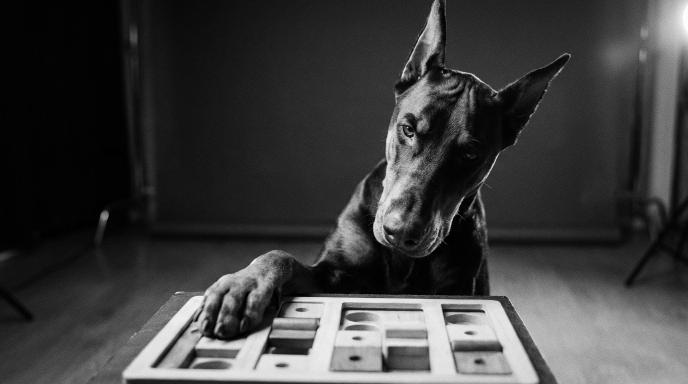
My Doberman, Max, destroyed three puzzle toys in his first week home. Not because they were poorly made—because he figured them out in under a minute, got bored, and decided the plastic was more fun to shred than the treats inside.
Sound familiar?
If you own a Doberman, you already know they’re not your average dog. These brilliant animals rank in the top 5 most intelligent breeds in the world. But here’s the problem: a bored Doberman is a destructive Doberman.
Regular walks aren’t enough. Basic training isn’t enough. Even standard “brain games” often fall short for these working dog geniuses. What your Doberman really needs are proper problem-solving games—activities that challenge their incredible brains and satisfy their deep need to work.
In this guide, you’ll discover 21 problem-solving games designed specifically for Dobermans. We’ll start with beginner games for puppies and work up to expert-level challenges that’ll stump even the smartest dogs. You’ll learn how to assess your dog’s level, build DIY puzzles on a budget, and troubleshoot common problems.
Let’s give that brilliant brain something productive to do.
- Why Dobermans Need Problem-Solving Games
- Understanding Your Doberman’s Problem-Solving Abilities
- Assessing Your Doberman’s Current Level
- Beginner Problem-Solving Games
- Intermediate Problem-Solving Games
- Advanced Problem-Solving Games
- Expert-Level Games for Genius Dobermans
- DIY Problem-Solving Games (Budget-Friendly)
- Progressive Difficulty System
- Troubleshooting Common Problems
- Creating a Daily Problem-Solving Routine
- Safety Considerations
- Taking It Further: Advanced Training
- Final Thoughts & Action Plan
Why Dobermans Need Problem-Solving Games
Your Doberman wasn’t bred to lie around looking pretty. Louis Dobermann created this breed in the 1890s to protect him while collecting taxes in dangerous neighborhoods. That required dogs who could think fast, make decisions, and solve problems independently.
Your dog inherited those traits. That big brain needs exercise just like those powerful muscles do.
Signs Your Doberman Needs More Cognitive Challenge
How do you know if your Doberman is mentally under-stimulated? Watch for these warning signs:
- Destructive chewing even after a long walk
- Obsessive behaviors like tail-chasing or pacing
- Excessive barking at everything
- Demanding constant attention from you
- Difficulty settling down or relaxing
- Inventing their own “games” (usually ones you don’t appreciate)
- Depression or lethargy despite physical health
If you’re seeing these behaviors, your Doberman’s brain is bored. They’re creating their own mental stimulation—and that rarely ends well for your furniture.
The Science: How Problem-Solving Games Benefit Doberman Brains
Here’s what happens when your Doberman solves puzzles:
Neural pathway development: Just like humans learning new skills, dogs build new connections in their brains when they problem-solve. This keeps their minds sharp as they age.
Delayed gratification training: Problem-solving games teach patience. Your Doberman learns that working through challenges leads to rewards—an essential life skill.
Executive function improvement: These games strengthen your dog’s ability to plan, focus, and control impulses. That translates to better behavior in everyday situations.
Natural confidence building: Successfully solving puzzles makes dogs feel accomplished and secure. A confident Doberman is a well-behaved Doberman.
Mental fatigue (the good kind): Twenty minutes of hard brain work can tire your dog more than an hour of fetch. Mental exhaustion leads to calm, relaxed behavior.
Think of problem-solving games as CrossFit for your Doberman’s brain. Physical exercise keeps the body fit; cognitive challenges keep the mind fit.
Understanding Your Doberman’s Problem-Solving Abilities
Before we dive into specific games, let’s understand what makes your Doberman such a problem-solving powerhouse.
Doberman Intelligence Ranking (Top 5 Breeds Explained)
According to canine psychologist Stanley Coren’s research, Dobermans rank as the 5th most intelligent dog breed. Here’s what that means:
Working and obedience intelligence: Dobermans learn new commands in fewer than 5 repetitions and obey first commands 95% of the time or better.
What this ranking really tells us: Your Doberman can learn a new problem-solving skill faster than almost any other breed. But they also get bored faster if you don’t keep increasing the challenge.
The flip side: High intelligence means high needs. A Border Collie or Poodle (ranked 1 and 2) faces the same challenge—brilliant brains need constant engagement.
How Dobermans Learn and Solve Problems
Dobermans approach problem-solving differently than other breeds:
Trial and error masters: They’ll try multiple approaches quickly, learning from each failed attempt.
Pattern recognition experts: Once they solve a puzzle, they remember the pattern. Change it up or they’ll get bored.
Visual and spatial learners: Dobermans excel at games requiring spatial reasoning and visual discrimination.
Independent workers: Unlike breeds that constantly look to humans for guidance, Dobermans prefer figuring things out themselves.
High frustration tolerance: They’ll persist longer than many breeds before giving up—if the reward is worth it.
Working Dog Instincts: The Foundation of Problem-Solving
Your Doberman’s problem-solving ability isn’t just intelligence—it’s instinct. Protection work requires:
- Environmental assessment: Constantly scanning and analyzing surroundings
- Threat evaluation: Deciding what’s dangerous and what’s safe
- Independent decision-making: Acting without waiting for human commands
- Persistence: Not giving up when facing obstacles
These same instincts make Dobermans natural puzzle solvers. They’re wired to analyze, assess, and act.
Common Doberman Problem-Solving Behaviors
You’ve probably seen your Doberman display these natural problem-solving behaviors:
- Testing objects with their paws before using their mouth
- Observing first before attempting a new challenge
- Using tools (like pushing a toy against furniture to access something)
- Following cause-and-effect chains (“If I do this, then that happens”)
- Generalizing solutions (applying a learned solution to new problems)
These behaviors show your dog is already thinking. Problem-solving games simply channel that thinking into positive activities.
Assessing Your Doberman’s Current Level
Not all Dobermans start at the same skill level. Age, experience, and individual personality all matter.
Beginner, Intermediate, Advanced, Expert – What Level Is Your Dog?
Beginner Level (Most 8-week to 6-month-old puppies):
- New to problem-solving games
- Short attention span (under 3 minutes)
- Needs obvious solutions
- Relies heavily on scent over visual cues
Intermediate Level (Most 6-month to 2-year-old dogs):
- Solved basic puzzles before
- Can focus for 5-10 minutes
- Understands cause-and-effect
- Starting to use multiple problem-solving strategies
Advanced Level (Most 2+ year adult dogs with regular mental enrichment):
- Solves intermediate puzzles quickly
- Focuses for 10-15 minutes
- Uses trial-and-error systematically
- Remembers solutions to previously solved puzzles
Expert Level (Gifted Dobermans of any age):
- Destroys store-bought puzzles in under 60 seconds
- Can focus for 15-20+ minutes
- Creates novel solutions you didn’t intend
- Needs custom-designed challenges
Quick Assessment Quiz (5 Questions)
Answer these to find your dog’s starting level:
- How quickly does your Doberman solve a simple three-cup shell game?
- A) What’s a shell game? (Beginner)
- B) 2-3 minutes (Intermediate)
- C) Under 30 seconds (Advanced)
- D) Instantly—they track the movement perfectly (Expert)
- How long can your Doberman stay focused on a puzzle before losing interest?
- A) Under 2 minutes (Beginner)
- B) 3-5 minutes (Intermediate)
- C) 5-10 minutes (Advanced)
- D) 10+ minutes, or until they solve it (Expert)
- When faced with a new puzzle, does your dog:
- A) Need your encouragement to try (Beginner)
- B) Try once or twice, then look at you for help (Intermediate)
- C) Systematically try different approaches (Advanced)
- D) Solve it faster than you expected (Expert)
- How many different problem-solving strategies does your dog use?
- A) Mostly just pawing or nosing randomly (Beginner)
- B) 2-3 basic strategies (Intermediate)
- C) 4-5 different approaches (Advanced)
- D) Creative solutions you didn’t anticipate (Expert)
- Has your Doberman ever “cheated” by flipping over a puzzle or finding an unintended solution?
- A) No, they haven’t figured that out yet (Beginner)
- B) Once or twice (Intermediate)
- C) Yes, regularly (Advanced)
- D) Always—they’re too smart for standard puzzles (Expert)
Mostly A’s: Start with Beginner games
Mostly B’s: Try Intermediate games
Mostly C’s: Jump to Advanced games
Mostly D’s: Head straight to Expert challenges
Age-Appropriate Expectations
Puppies (8 weeks – 6 months): Don’t expect too much too soon. Puppy brains are still developing. Focus on building confidence and positive associations with problem-solving. Sessions should be very short—under 5 minutes.
Adolescents (6 months – 2 years): This is prime learning time. Your Doberman’s brain is mature enough for complex challenges but still flexible enough to learn quickly. Expect rapid progress.
Adults (2-7 years): Peak cognitive performance. Adult Dobermans can handle the most difficult challenges and longest sessions. This is when you’ll see their full problem-solving potential.
Seniors (7+ years): Older Dobermans may slow down physically, but their minds stay sharp. Keep challenging them with problem-solving games to maintain cognitive function. Adjust for any vision or mobility issues.
Beginner Problem-Solving Games
Perfect for puppies or Dobermans new to brain games. These build foundational skills and confidence.
Game #1: The Cup Game
Materials needed: 3 plastic cups, high-value treats
Step-by-step instructions:
- Show your Doberman a treat
- Place three cups upside down in a row
- Let your dog watch as you hide the treat under one cup
- Shuffle the cups slowly
- Say “Find it!” and let them investigate
- Reward heavily when they find the treat
What skill it builds: Visual tracking, focus, basic cause-and-effect
Doberman-specific tip: Start with just two cups. Dobermans pick this up so fast that three cups might be too easy from day one. Once they’re consistent, add the third cup.
Game #2: Towel Roll Puzzle
Materials needed: One bath towel, treats
Step-by-step instructions:
- Lay the towel flat on the floor
- Sprinkle 5-10 treats along one edge
- Roll the towel up with treats inside
- Let your Doberman figure out how to unroll it
What skill it builds: Persistence, paw dexterity, problem-solving through manipulation
Doberman-specific tip: Start with a loose roll. Dobermans have strong jaws and might try to rip the towel instead of unrolling it. Reward gentle unrolling behavior specifically.
Game #3: Treat Under a Toy
Materials needed: Treats, a lightweight toy or plastic container
Step-by-step instructions:
- Show your dog a treat
- Place the treat on the floor
- Cover it with an upside-down plastic container or toy
- Let your dog figure out how to move the object
What skill it builds: Object permanence (understanding things exist even when hidden), basic spatial problem-solving
Doberman-specific tip: Use a container light enough for your dog to move easily. The goal is building confidence, not frustration.
Game #4: Simple Hide and Seek
Materials needed: Just treats (or a favorite toy)
Step-by-step instructions:
- Have your Doberman sit-stay (or have someone hold them)
- Let them watch you hide a treat in an obvious spot
- Release them with “Find it!”
- Celebrate when they find it
- Gradually hide treats in harder spots
What skill it builds: Scent tracking, memory, environmental scanning
Doberman-specific tip: Dobermans have excellent noses but are visual learners. Start with treats in plain sight, then gradually hide them so your dog learns to use their nose.
Game #5: Which Hand?
Materials needed: Just treats in your pocket
Step-by-step instructions:
- Show your dog you have a treat
- Put both hands behind your back
- Place the treat in one hand
- Bring both closed fists forward
- Let your dog sniff and choose which hand
- Open the chosen hand
- If correct, they get the treat. If wrong, show the empty hand and try again
What skill it builds: Scent discrimination, decision-making, impulse control
Doberman-specific tip: Once your Doberman masters this, increase difficulty by not letting them see which hand you put it in. They’ll have to rely purely on scent.
Intermediate Problem-Solving Games
For Dobermans who’ve mastered the basics and are ready for more complex challenges.
Game #6: Muffin Tin Puzzle
Materials needed: Standard 12-cup muffin tin, 12 tennis balls, treats
Step-by-step instructions:
- Place treats in several muffin cups (start with all 12)
- Cover each cup with a tennis ball
- Let your Doberman remove balls to access treats
- Gradually reduce to only 6 cups with treats, then 3
What skill it builds: Systematic searching, persistence when some attempts don’t pay off, paw-eye coordination
Doberman-specific tip: Dobermans will try to flip the entire tin over. That’s actually brilliant problem-solving! You can allow it or secure the tin to make them solve it the “intended” way.
Game #7: Cardboard Box Challenge
Materials needed: Several cardboard boxes of different sizes, treats
Step-by-step instructions:
- Place a treat inside a small box
- Close the box (tape it lightly if needed)
- Let your Doberman figure out how to open it
- Level up: Put the small box inside a larger box (nesting puzzle)
- Advanced: Fill a box with crumpled newspaper with treats hidden throughout
What skill it builds: Multi-step problem-solving, using mouth and paws together, persistence
Doberman-specific tip: Supervise closely. Some Dobermans will systematically dismantle the box, which is valid problem-solving. Others might try to eat the cardboard—redirect that behavior.
Game #8: Bottle Spin Game
Materials needed: Empty plastic water bottle, wooden dowel or sturdy stick, treats
DIY construction:
- Remove the bottle cap and label
- Cut small holes in the bottle sides
- Mount the bottle horizontally on a dowel so it spins freely
- Support the dowel between two stable objects
How to play:
- Drop treats inside through the opening
- Your dog must spin the bottle to get treats to fall out
What skill it builds: Cause-and-effect understanding, tool use, patience
Doberman-specific tip: Make sure the bottle spins easily. Dobermans can be rough, so secure it well to prevent them from knocking down the whole setup.
Game #9: Name That Toy
Materials needed: 3-5 distinctly different toys, treats
Step-by-step instructions:
- Start with two toys (like a rope and a ball)
- Hold up the rope, say “rope” repeatedly while your dog examines it
- Do the same with the ball
- Place both toys on the floor
- Ask “Get the rope!” and reward heavily when they choose correctly
- Add one new toy at a time once they’ve mastered the previous ones
What skill it builds: Object discrimination, language comprehension, memory
Doberman-specific tip: Dobermans can learn 50+ toy names. This game has almost unlimited growth potential. Keep adding new toys to challenge them.
Game #10: Treasure Hunt with Scent Markers
Materials needed: High-value treats, your yard or home
Step-by-step instructions:
- Start by hiding treats while your dog watches
- Use the “Find it!” command
- Once they understand, hide treats while they’re in another room
- Advanced: Rub treats on objects, then hide the actual treat nearby (they have to track the scent trail)
What skill it builds: Advanced scent work, environmental scanning, persistence
Doberman-specific tip: Dobermans excel at this. Make it harder by hiding treats in elevated spots (on low chairs or benches), not just on the ground.
Game #11: Obstacle Course with Commands
Materials needed: Household items (broom handles, boxes, chairs, hula hoop)
Step-by-step instructions:
- Create a simple obstacle course
- Guide your dog through using commands (“jump,” “through,” “around”)
- The problem-solving element: Vary the course each time so they can’t just memorize it
What skill it builds: Spatial reasoning, command differentiation, adaptability
Doberman-specific tip: Add mental challenges between physical obstacles. For example: jump, then sit-stay, then go through the tunnel. This combines physical and cognitive work.
Advanced Problem-Solving Games
For adult Dobermans who solve intermediate puzzles quickly.
Game #12: Multi-Step Puzzle Chains
Materials needed: Combination of previous puzzles
How it works: Chain multiple puzzles together. For example:
- Solve the cup game to find a key
- Use the key to open a drawer
- Inside the drawer is a toy they must retrieve
- Bring you the toy to get the final treat
What skill it builds: Sequential problem-solving, memory, patience
Doberman-specific tip: Film this game. Watching your Doberman work through a multi-step challenge is incredibly impressive and makes great social media content!
Game #13: String Pull Puzzle
Materials needed: String or rope, treat, furniture
Step-by-step instructions:
- Tie a treat to the end of a rope
- Hide the treat under a couch or low table where your dog can’t reach it with paw or mouth
- Leave the string visible and reachable
- Your dog must figure out to pull the string to retrieve the treat
What skill it builds: Tool use, cause-and-effect chains, innovative thinking
Doberman-specific tip: This is genuinely difficult. Some dogs never figure it out. If your Doberman solves this, they’re exceptionally smart.
Game #14: Lever and Platform Puzzle
Materials needed: Small platform or board, fulcrum (block of wood), treat
DIY construction: Create a simple seesaw: Place a board on a fulcrum so it tilts. Put a treat on the raised end.
How to play: Your dog must press down on the low end to tip the board and access the treat on the raised end.
What skill it builds: Physics understanding, tool manipulation, problem-solving
Doberman-specific tip: Make sure the setup is stable. Dobermans will test it vigorously.
Game #15: Memory Sequence Games
Materials needed: 3-5 toys your dog knows by name
Step-by-step instructions:
- Line up several toys
- Give a sequence command: “Get the ball, then the rope, then the duck”
- Your dog must retrieve them in order
What skill it builds: Working memory, sequential processing, impulse control
Doberman-specific tip: Start with just two items in sequence. Dobermans can work up to 5-6 items if you train gradually.
Game #16: Object Discrimination Challenges
Materials needed: Similar-looking items with slight differences, treats
How it works: Hide treats under one specific type of object (like “always under the red cup”) among similar objects (other colored cups). Your dog must learn the pattern.
What skill it builds: Pattern recognition, discrimination, rule learning
Doberman-specific tip: Once they’ve learned one pattern, change the rule. Now it’s “always under the biggest cup” or “always under the square object.” This forces them to think flexibly.
Game #17: Problem-Solving Relay
Materials needed: Multiple rooms, treats, several challenges
How it works: Set up a course where your dog must solve several problems in sequence to reach the final reward. For example:
- Solve a puzzle in the living room to find a clue
- That clue directs them to the kitchen
- In the kitchen, they must complete another challenge
- That leads to the final treat location
What skill it builds: Complex sequential thinking, memory, persistence
Doberman-specific tip: This is an excellent rainy-day activity that burns serious mental energy.
Expert-Level Games for Genius Dobermans
For the Dobermans who make standard puzzles look like toddler toys.
Game #18: Custom Multi-Chamber Puzzle Box
What it is: A DIY puzzle requiring multiple different actions to access treats—sliding panels, lifting lids, rotating pieces, etc.
How to create: Use a wooden box with compartments. Design it so your dog must:
- Slide one panel to reveal a lever
- Pull the lever to unlock a lid
- Lift the lid to access the treat
What skill it builds: Complex problem-solving, multi-step thinking, tool use
Doberman-specific tip: Search “DIY dog puzzle box” online for construction ideas. Make it Doberman-proof by using durable materials.
Game #19: Scent Discrimination with 5+ Odors
Materials needed: Formal nose work kit with multiple scents
How it works: Train your Doberman to identify specific scents (birch, anise, clove, etc.) and indicate when they find the target scent among distractors.
What skill it builds: Advanced scent discrimination, focus, indicator behavior
Doberman-specific tip: This can lead to formal nose work competitions. Many Dobermans excel in this sport.
Game #20: Chain Behavior Problem-Solving
What it is: A complex sequence of behaviors your dog must perform without prompting.
Example chain: Go to your bed → pick up a specific toy → bring it to me → drop it in a basket → return to your bed → wait for release command
What skill it builds: Extreme memory, sequential processing, independence
Doberman-specific tip: Build this gradually over weeks. It’s one of the most cognitively demanding games possible.
Game #21: Independent Puzzle Solving (No Human Help)
How it works: Give your Doberman a challenging puzzle and leave the room. They must solve it entirely independently without your encouragement or guidance.
What skill it builds: Independence, confidence, persistence
When Store-Bought Puzzles Are Too Easy: If your Doberman destroys commercial puzzles in seconds, you’ve reached elite level. Options:
- Design custom puzzles
- Combine multiple puzzles
- Join dog sports (nose work, agility, rally obedience)
- Consider getting a second Doberman (seriously—they’ll challenge each other)
DIY Problem-Solving Games (Budget-Friendly)
You don’t need expensive toys. Here are five DIY games with full instructions.
PVC Pipe Puzzle Feeder
Materials: PVC pipe (4-inch diameter, 8-10 inches long), two end caps, drill
Cost: $5-8
Instructions:
- Drill 4-6 holes in the pipe (big enough for kibble to fall out)
- Put end caps on both ends
- Fill with kibble through a hole
- Your dog must roll it to dispense food
Egg Carton Foraging Game
Materials: Cardboard egg carton, treats
Cost: Free
Instructions:
- Place treats in several egg compartments
- Close the lid
- Optional: Tape lightly for added challenge
- Your dog must open compartments to access treats
Tennis Ball Muffin Tin Variation
Materials: Muffin tin, tennis balls, treats
Cost: $0 (if you have these items)
Instructions: As described in Game #6, but this is so effective it’s worth repeating in the DIY section.
Snuffle Mat from Old T-Shirts
Materials: Rubber sink mat with holes, old fabric strips, scissors
Cost: $3-5
Instructions:
- Cut t-shirts into 6-inch strips
- Tie strips through the mat holes
- Create a shaggy texture
- Hide kibble deep in the fabric
- Your dog must sniff and forage
Treat-Dispensing Bottle Contraption
Materials: Plastic bottle, rope, doorway
Cost: Free
Instructions:
- Remove cap and label from a bottle
- Cut holes for treats to fall out
- Thread rope through the bottle
- Hang it in a doorway at your dog’s height
- They must bat it around to dispense treats
Progressive Difficulty System
Don’t jump from beginner to expert overnight. Here’s how to scale up properly.
How to Scale Difficulty Up
Method 1: Add steps
If your dog solves a two-step puzzle easily, make it three steps, then four.
Method 2: Reduce obviousness
Start with visible solutions, gradually make them hidden.
Method 3: Add time delays
Make your dog wait 10 seconds, then 30 seconds, then a minute before allowing them to solve the puzzle.
Method 4: Combine games
Chain multiple puzzles together for compound challenges.
Signs It’s Time to Advance
- Solves current puzzles in under 30 seconds
- Shows boredom or disinterest
- Tries to skip steps or “cheat”
- Looks to you for help because the game is too easy
Creating a Monthly Progression Plan
Week 1: Introduce 3 beginner games
Week 2: Master those games, add 2 intermediate games
Week 3: Rotate between beginner and intermediate
Week 4: Start introducing 1-2 advanced games
Ongoing: Keep challenging as skills improve
Troubleshooting Common Problems
My Doberman Destroys Puzzles Instead of Solving Them
Why it happens: Frustration, excess energy, or lack of understanding
Solutions:
- Start with much easier puzzles to build confidence
- Ensure your dog has had physical exercise first
- Supervise and redirect destructive behavior immediately
- Use more durable materials
- Show them the solution once or twice first
My Dog Gets Frustrated and Gives Up
Why it happens: Puzzle is too difficult, or your dog hasn’t learned persistence yet
Solutions:
- Drop back to easier games
- Help them succeed—guide them to the solution
- Use extremely high-value rewards
- Keep sessions very short (under 3 minutes)
- End on success always
My Doberman Cheats (Flipping the Whole Puzzle Over)
Why it happens: Your dog is brilliant and found the most efficient solution
Solutions:
- Celebrate it! That’s problem-solving at its finest
- If you want them to solve it “correctly,” secure the puzzle so flipping isn’t possible
- Design puzzles where flipping doesn’t help
Low Food Motivation – Alternative Rewards
Why it happens: Some Dobermans aren’t food-driven
Solutions:
- Use play as a reward (tug, fetch) after solving
- Try different treats—real meat, cheese, hot dogs
- Play before meals when they’re hungry
- Use toys as the hidden “reward” instead of food
Puzzle Aggression or Resource Guarding
Why it happens: High-value resources trigger guarding behavior
Solutions:
- Practice “drop it” and “leave it” separately first
- Never approach your dog while they’re working a puzzle
- Use lower-value rewards that don’t trigger guarding
- Consult a professional trainer for serious aggression
No Interest in Games
Why it happens: Lack of proper introduction, low motivation, or health issues
Solutions:
- Make rewards extremely high-value
- Play when your dog is most alert (not tired)
- Show enthusiasm yourself—engagement is contagious
- Rule out health issues affecting energy or motivation
- Try different game types—some dogs prefer scent games over manipulation puzzles
Creating a Daily Problem-Solving Routine
Consistency matters more than marathon sessions.
Morning (5-10 minutes):
Quick puzzle game or scent work while you prepare for your day
Midday (10-15 minutes):
More intensive problem-solving session when you’re both alert
Evening (5-10 minutes):
Calm puzzle activity to wind down before bed
Weekly Challenge:
One day per week, introduce a brand-new game or significantly increase difficulty
Balancing Physical and Mental Exercise:
- Mental games before physical exercise calms excited dogs
- Physical exercise before mental games works better for hyper dogs
- Experiment to see what works for your Doberman
Safety Considerations
Supervising Games
Always watch your Doberman during problem-solving games, especially new ones. Intelligent dogs find creative (sometimes dangerous) solutions.
Choking Hazards to Avoid
- Small balls that fit entirely in their mouth
- Puzzle pieces that can break off
- Fabric that can be swallowed
- Thin plastic that shatters into sharp pieces
When to Retire Worn Toys
Replace puzzles when:
- Pieces are loose or cracked
- Your dog can access treats without solving the puzzle
- Materials are fraying or deteriorating
- Sharp edges appear from damage
Managing Frustration Safely
If your Doberman shows signs of serious frustration (growling, frantic behavior, shutting down), end the session immediately. Make the puzzle easier next time.
Taking It Further: Advanced Training
Once your Doberman has mastered home games, consider these outlets:
Nose Work Classes: Competitive scent detection sport where dogs search for specific odors. Dobermans’ working heritage makes them naturals.
Rally Obedience: A course with stations requiring different behaviors. It’s problem-solving with your human partner.
Agility Training: Physical obstacles that require mental planning and decision-making.
Trick Dog Titles: Organizations like AKC offer titles for dogs who learn increasingly complex tricks.
Final Thoughts & Action Plan
Your Doberman’s intelligence is both a gift and a responsibility. That brilliant brain needs work every single day.
The good news? Problem-solving games are fun. You’ll laugh watching your dog figure out puzzles. You’ll feel proud when they solve something challenging. And you’ll enjoy the calm, satisfied Doberman who emerges after a good mental workout.
Your First 3 Games to Start Today:
- The Cup Game (5 minutes) – Start right now with three cups and treats
- Towel Roll Puzzle (5 minutes) – Try it this evening
- Simple Hide and Seek (10 minutes) – Perfect for tomorrow morning
How to Track Progress:
Keep a simple log:
- Date
- Game played
- Time to solve
- Difficulty level
- Notes on your dog’s approach
Watch for improvement over weeks and months. You’ll be amazed how fast your Doberman learns.
Remember:
- Start at the right level for your dog
- Increase difficulty gradually
- End sessions on success
- Make it fun, not stressful
- Consistency beats intensity
Your Doberman’s brain is one of the most powerful tools in the animal kingdom. These problem-solving games give that brain the workout it craves.
Now go give your genius dog something worthy of their intelligence.