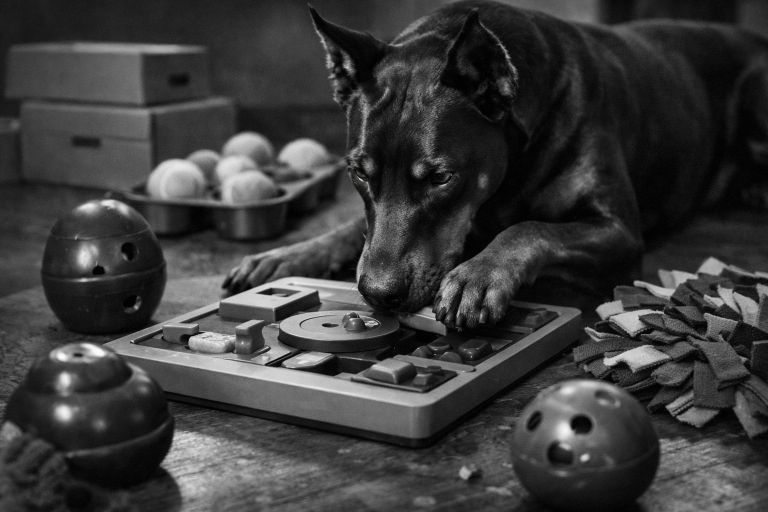
Affiliate Disclosure: Some of the links in this post are affiliate links. This means we may earn a small commission if you make a purchase through these links—at no extra cost to you. We only recommend products and tools that we genuinely believe will help you with your Doberman.
Is your Doberman destroying every toy you buy in under five minutes? Does your intelligent pup seem bored even after an hour-long walk? You’re not alone—and you’re definitely not imagining it.
Dobermans are wickedly smart. They’re one of the top five most intelligent dog breeds in the world. That brilliant brain needs more than just physical exercise to stay happy and healthy. Without mental challenges, your Doberman can become anxious, destructive, or downright miserable.
That’s where puzzle toys come in.
In this guide, you’ll discover exactly which puzzle toys actually work for Dobermans. We’re talking about toys that survive those powerful jaws, toys that challenge that sharp mind, and toys that keep your dog busy for more than thirty seconds.
We’ll cover 15 tested recommendations, show you how to choose the right difficulty level, teach you how to introduce puzzles properly, and even share DIY ideas you can make at home today.
Whether you have an 8-week-old puppy or a 5-year-old adult, this guide has you covered.
Let’s find the perfect puzzle toys for your Doberman.
- Why Puzzle Toys Matter for Dobermans
- Understanding Puzzle Toy Difficulty Levels
- Top 15 Puzzle Toy Recommendations for Dobermans
- The 3-2-1 Puzzle Toy Rotation System
- How to Introduce Puzzle Toys to Your Doberman
- DIY Puzzle Toy Ideas for Dobermans
- Troubleshooting Common Puzzle Toy Problems
- Puzzle Toys by Age & Life Stage
- Safety Guidelines for Puzzle Toys
- Beyond Puzzles: Alternative Enrichment for Dobermans
- Frequently Asked Questions
- Bringing It All Together: Your Action Plan
Why Puzzle Toys Matter for Dobermans
The Doberman Brain: Built for Problem-Solving
Your Doberman wasn’t bred to lie around looking pretty. These dogs were created to think, work, and solve problems. They were designed to protect property, make split-second decisions, and stay alert for hours.
That working dog heritage means your Doberman has a brain that craves challenges.
Think about it: A bored Doberman is like a genius kid stuck in a classroom with nothing to do. They’ll find ways to entertain themselves—and you probably won’t like what they come up with.
Here’s what happens when Dobermans don’t get enough mental stimulation:
- Chewing furniture, shoes, or walls
- Excessive barking at every little sound
- Digging holes in your yard
- Following you obsessively around the house
- Hyperactivity even after exercise
- Anxiety and stress behaviors
Physical exercise alone isn’t enough. You can walk your Doberman for two hours, and they’ll still have energy to spare if their brain isn’t tired.
What Puzzle Toys Actually Do
Puzzle toys give your Doberman a job. They create challenges that engage the mind, build problem-solving skills, and provide that sense of accomplishment dogs crave.
Here’s what good puzzle toys accomplish:
✅ Tire the brain – 15 minutes of puzzle work can equal 30 minutes of physical exercise
✅ Reduce anxiety – Focused problem-solving calms nervous dogs
✅ Prevent boredom – A busy brain doesn’t look for trouble
✅ Slow down eating – If used at mealtime, puzzles prevent gulping and bloat
✅ Build confidence – Successfully solving puzzles makes dogs feel capable and proud
Mental Exercise = A Tired, Happy Dog
You know that satisfied, peaceful look your Doberman gets after a really good training session? That’s what puzzle toys create.
A mentally exhausted Doberman is calm, content, and well-behaved. They’re not pacing, whining, or getting into mischief. They’re relaxed because their brain got the workout it needed.
And the best part? You don’t need an hour. Just 15-20 minutes of quality puzzle time can transform your dog’s entire day.
Understanding Puzzle Toy Difficulty Levels
Not all puzzle toys are created equal. Some are so easy your Doberman will solve them in ten seconds. Others are so hard your dog will give up in frustration.
The key is matching the puzzle to your dog’s current skill level—and then gradually increasing the challenge as they improve.
The Doberman Puzzle Difficulty Matrix
Think of puzzle toys like video game levels. You don’t start with the final boss battle. You work your way up.
Here’s how to think about puzzle difficulty for Dobermans:
Level 1: Beginner
Best for: Puppies (8-16 weeks) / Dogs new to puzzles / First-time puzzle users
What it looks like:
- Single-step solutions
- Instant rewards
- Simple rolling or tipping actions
- No complex sequences
Examples: Kong Wobbler, West Paw Toppl, basic treat-dispensing balls
Goal: Build positive associations with puzzle toys. Your dog learns that interacting with toys = treats appear.
Level 2: Intermediate
Best for: Juveniles (4-12 months) / Dogs with some puzzle experience
What it looks like:
- Multi-step challenges
- Sliding or lifting pieces
- Requires a bit of patience
- May take 5-10 minutes to solve
Examples: Nina Ottosson Dog Brick, Outward Hound Hide N’ Slide
Goal: Develop problem-solving strategies. Your dog learns to try different approaches when one doesn’t work.
Level 3: Advanced
Best for: Adult dogs / Dogs who’ve mastered intermediate puzzles
What it looks like:
- Complex sequences required
- Multiple hidden compartments
- Pieces must be moved in specific order
- Takes 10-20 minutes to solve
Examples: Nina Ottosson Dog Casino, Trixie Flip Board
Goal: Challenge strategic thinking. Your dog must remember patterns and use logic.
Level 4: Expert
Best for: Puzzle masters / Doberman geniuses / Dogs who need maximum challenge
What it looks like:
- Combination locks or rotating layers
- Memory-based challenges
- Multiple problem-solving strategies required
- Can take 20-30 minutes
Examples: Nina Ottosson Dog Tornado, advanced West Paw Qwizl stuffing methods
Goal: Push cognitive limits. These puzzles keep even the smartest Dobermans engaged.
How to Know Your Dog’s Current Level
Signs your dog is ready to level up:
- Solves current puzzle in under 2 minutes
- Shows no frustration
- Seems excited when puzzle appears
- Checks all hiding spots systematically
Signs a puzzle is too difficult:
- Gives up within 30 seconds
- Walks away
- Shows stress signals (whining, pacing, excessive panting)
- Tries to chew or destroy the puzzle in frustration
The “3-Success Rule”:
Once your dog successfully solves a puzzle three sessions in a row without help, it’s time to level up.
Top 15 Puzzle Toy Recommendations for Dobermans
Now for the good stuff—the actual toys that work for Dobermans. Each recommendation includes difficulty level, durability rating, and specific notes for our powerful, intelligent breed.
BEGINNER PUZZLES (Level 1)
1. West Paw Toppl
Difficulty: ★☆☆☆☆
Durability: ★★★★★ (5/5 bones)
Best for: Puppies, first-time puzzle users, slow feeding
Price: Budget ($10-15)
What it is: A cone-shaped rubber toy with a hollow center. Fill it with treats, and your dog tips, rolls, and licks to get them out.
Why Dobermans love it: The West Paw Toppl is virtually indestructible. Dobermans can chew on it all day without making a dent. The large size is perfect for adult Dobermans, and you can even interlock two Toppls for extra challenge.
Doberman-specific notes:
- Get the LARGE size for adults (the small is too easy to swallow)
- Freeze it with peanut butter and kibble for a longer challenge
- Dishwasher safe—easy to keep clean
- Made in the USA with non-toxic materials
Pros: Indestructible, versatile, grows with your dog
Cons: Too easy for experienced puzzle solvers
Where to buy: Amazon, Chewy
2. Kong Wobbler
Difficulty: ★☆☆☆☆
Durability: ★★★★☆ (4/5 bones)
Best for: Meal replacement, beginner puzzle dogs
Price: Budget ($15-20)
What it is: A weighted, egg-shaped toy that wobbles and dispenses kibble as your dog bats it around.
Why Dobermans love it: It combines physical activity with mental challenge. Your Doberman has to figure out how hard to hit it and which direction makes treats fall out.
Doberman-specific notes:
- Great for slowing down fast eaters
- Adjustable opening size (start wide, make smaller as dog improves)
- Weighted bottom keeps it upright
- Can be loud on hardwood floors
Pros: Simple to use, good for mealtime, adjustable difficulty
Cons: Not super durable if dog tries to chew it; noise on hard surfaces
Where to buy: Amazon, Chewy, most pet stores
3. Kong Extreme (Classic)
Difficulty: ★☆☆☆☆ (depends on how you stuff it)
Durability: ★★★★★ (5/5 bones)
Best for: All ages, power chewers, anxiety relief
Price: Budget ($10-18)
What it is: The legendary black rubber Kong. Not technically a puzzle, but becomes one when stuffed creatively.
Why Dobermans love it: This is the toy that survives Doberman jaws. The classic Kong has been around for decades because it simply works.
Doberman-specific notes:
- Get the XXL size for adult Dobermans
- Freeze with layers (kibble + peanut butter + yogurt + treats) for hours of entertainment
- Perfect for crate training
- The black “Extreme” version is tougher than the red original
Pros: Legendary durability, endless stuffing variations, affordable
Cons: Not a true puzzle unless you stuff it creatively
Where to buy: Everywhere—Amazon, Chewy, pet stores, even some grocery stores
INTERMEDIATE PUZZLES (Level 2)
4. Outward Hound Dog Brick
Difficulty: ★★☆☆☆
Durability: ★★★☆☆ (3/5 bones)
Best for: Juveniles (4-12 months), puzzle beginners
Price: Budget ($10-15)
What it is: A plastic board with sliding compartments and removable bone pieces. Dogs slide pieces to reveal hidden treats.
Why Dobermans love it: It’s a great introduction to “real” puzzle toys. The sliding action teaches problem-solving without being too frustrating.
Doberman-specific notes:
- SUPERVISE CLOSELY—the plastic isn’t super durable
- Some Dobermans will try to brute-force it instead of solving it
- Great stepping stone to harder puzzles
- Dishwasher safe (top rack)
Pros: Affordable, good intro to sliding puzzles, multiple hiding spots
Cons: Not very durable; determined Dobermans can chew pieces
Where to buy: Amazon, Chewy
5. Nina Ottosson Dog Smart
Difficulty: ★★☆☆☆
Durability: ★★★☆☆ (3/5 bones)
Best for: Intermediate learners, dogs ready for multi-step puzzles
Price: Mid-range ($15-25)
What it is: A composite wood puzzle with bone-shaped pieces that must be lifted to reveal treats underneath.
Why Dobermans love it: It requires thinking, not just brute strength. Your dog has to figure out that lifting (not chewing) gets results.
Doberman-specific notes:
- Teaches gentle manipulation instead of destruction
- Not chew-proof—supervise always
- Multiple compartments keep interest high
- Can flip over if dog gets frustrated
Pros: Good difficulty progression, multiple hiding spots, teaches patience
Cons: Can be destroyed by rough handling; not suitable for unsupervised use
Where to buy: Amazon, Chewy
6. West Paw Qwizl
Difficulty: ★★☆☆☆ (depends on stuffing method)
Durability: ★★★★★ (5/5 bones)
Best for: Treat dispensing + chewing combo
Price: Mid-range ($15-20)
What it is: A hollow, twisty rubber toy with a curved shape. Your dog squeezes and twists it to release treats.
Why Dobermans love it: It’s a puzzle AND a chew toy in one. The genius design means treats don’t fall out easily—your dog has to work for them.
Doberman-specific notes:
- Virtually indestructible
- Get the LARGE size
- Dishwasher safe
- Made in USA with non-toxic materials
- Can stuff with peanut butter, spray cheese, or kibble
Pros: Indestructible, unique challenge, multi-use
Cons: Some dogs need help understanding how it works at first
Where to buy: Amazon, Chewy
7. Busy Buddy Twist ‘n Treat
Difficulty: ★★☆☆☆
Durability: ★★★★☆ (4/5 bones)
Best for: Intermediate dogs, adjustable challenge
Price: Budget ($10-15)
What it is: Two rubber halves that twist together. Treats are stored inside, and the opening size is adjustable.
Why Dobermans love it: The difficulty grows with your dog. Start with a wide opening, then make it smaller as your dog improves.
Doberman-specific notes:
- Rubber construction holds up well
- Can roll under furniture (annoying but harmless)
- Clean regularly—treats can get stuck inside
- Get the large size
Pros: Adjustable difficulty, durable, affordable
Cons: Can roll away; needs regular cleaning
Where to buy: Amazon, Chewy
ADVANCED PUZZLES (Level 3)
8. Nina Ottosson Dog Casino
Difficulty: ★★★☆☆
Durability: ★★★☆☆ (3/5 bones)
Best for: Smart adults, experienced puzzle solvers
Price: Premium ($25-35)
What it is: A multi-layered puzzle with drawers, compartments, and sliding pieces. Dogs must complete multiple steps to access all treats.
Why Dobermans love it: This is a TRUE brain workout. It requires memory, problem-solving, and patience.
Doberman-specific notes:
- Composite wood construction—NOT chew-proof
- Supervise every session
- Best for dogs who’ve mastered easier puzzles
- Provides 15-20 minutes of focused work
Pros: Highly challenging, beautiful design, multiple steps
Cons: Expensive, not durable if unsupervised, can frustrate beginners
Where to buy: Amazon, Chewy
9. Trixie Flip Board
Difficulty: ★★★☆☆
Durability: ★★☆☆☆ (2/5 bones)
Best for: Advanced learners who need variety
Price: Mid-range ($20-30)
What it is: A board with multiple types of compartments—flips, slides, lifts, and cones.
Why Dobermans love it: Variety! Each compartment requires a different strategy, so dogs stay engaged longer.
Doberman-specific notes:
- Plastic can crack with rough handling
- Non-slip base helps
- Best for gentle puzzle solvers
- Not suitable for frustrated chewers
Pros: Multiple challenge types in one toy, keeps dogs thinking
Cons: Not very durable; plastic edges can be chewed
Where to buy: Amazon, Chewy
10. Outward Hound Hide N’ Slide (Advanced)
Difficulty: ★★★☆☆
Durability: ★★★☆☆ (3/5 bones)
Best for: Dogs who mastered beginner puzzles
Price: Mid-range ($15-25)
What it is: A board with compartments that lock and must be slid in the correct sequence to open.
Why Dobermans love it: It requires strategy, not just random poking. Your dog has to figure out the pattern.
Doberman-specific notes:
- Non-slip base (important!)
- Dishwasher safe
- Some Dobermans will try to chew edges if frustrated
- Good middle ground between easy and expert
Pros: Sequential challenge, dishwasher safe, multiple compartments
Cons: Determined chewers may damage edges
Where to buy: Amazon, Chewy
EXPERT PUZZLES (Level 4)
11. Nina Ottosson Dog Tornado
Difficulty: ★★★★☆
Durability: ★★★☆☆ (3/5 bones)
Best for: Puzzle masters only
Price: Premium ($30-40)
What it is: A rotating, multi-layered puzzle. Layers must be spun and aligned perfectly to reveal hidden treats.
Why Dobermans love it: This is Mount Everest for dog puzzles. Only the smartest, most experienced dogs can master it.
Doberman-specific notes:
- Not for beginners—will cause frustration
- Composite wood—supervise always
- Can be flipped over if dog gets frustrated
- Provides 20-30 minutes of challenge for experts
Pros: Ultimate challenge, gorgeous design, highly engaging
Cons: Expensive, fragile, only suitable for experienced dogs
Where to buy: Amazon, Chewy
12. Trixie Activity Flip Board
Difficulty: ★★★★☆
Durability: ★★☆☆☆ (2/5 bones)
Best for: Experienced dogs who need maximum variety
Price: Mid-range ($25-35)
What it is: Seven different compartment types on one board—flips, cones, sliders, and more.
Why Dobermans love it: No two hiding spots are the same. Your dog has to use different skills for each section.
Doberman-specific notes:
- Plastic construction—not super durable
- Best for gentle puzzle solvers
- Offers incredible variety
- Non-slip rubber feet
Pros: Maximum variety, keeps dogs engaged, multiple challenge types
Cons: Not durable; can crack with rough use
Where to buy: Amazon, Chewy
TREAT-DISPENSING BALLS & ROLLING TOYS
13. OurPets Smarter Toys IQ Treat Ball
Difficulty: ★★☆☆☆
Durability: ★★★★☆ (4/5 bones)
Best for: Active dogs, meal replacement
Price: Budget ($8-12)
What it is: A hard plastic ball with an adjustable opening. Your dog rolls it around to dispense kibble.
Why Dobermans love it: It combines physical exercise with problem-solving. Great for high-energy dogs.
Doberman-specific notes:
- Adjustable difficulty dial
- Can be loud on hard floors
- Good for using up excess energy
- Get the large size
Pros: Combines mental and physical exercise, adjustable, affordable
Cons: Loud, can roll under furniture
Where to buy: Amazon, Chewy
14. Planet Dog Orbee-Tuff Mazee
Difficulty: ★★★☆☆
Durability: ★★★★★ (5/5 bones)
Best for: Chewers, outdoor use
Price: Mid-range ($15-20)
What it is: A bouncy, mint-infused ball with internal maze pathways for treats.
Why Dobermans love it: It’s nearly indestructible, bounces unpredictably, and smells good (mint-infused rubber).
Doberman-specific notes:
- Floats (great for water-loving Dobermans)
- Bounces erratically for extra challenge
- Mint scent is appealing
- Can be hard to clean
Pros: Nearly indestructible, unique texture, multi-use (fetch + puzzle)
Cons: Harder to clean than smooth toys
Where to buy: Amazon, Chewy
SNUFFLE & SCENT WORK
15. Snuffle Mat (Various Brands)
Difficulty: ★☆☆☆☆
Durability: ★★☆☆☆ (2/5 bones)
Best for: Nose work, calming activity, anxious dogs
Price: Budget ($15-25)
What it is: A mat with fabric strips where you hide treats. Your dog uses their nose to sniff them out.
Why Dobermans love it: It taps into natural foraging instincts. Sniffing is mentally exhausting and calming.
Doberman-specific notes:
- Great for anxious or reactive Dobermans
- Slows down fast eaters
- Can be destroyed by determined chewers—supervise
- Machine washable
Pros: Calming activity, uses nose (different from paw puzzles), slows eating
Cons: Not durable for rough play; some dogs will try to shred it
Where to buy: Amazon, Chewy, Etsy (handmade options)
The 3-2-1 Puzzle Toy Rotation System
Here’s a mistake most Doberman owners make: They buy five puzzle toys and leave them all out at once.
Within a week, the dog is bored with every single one.
Why? Because familiarity kills interest. Your Doberman needs novelty to stay engaged.
That’s where the 3-2-1 Rotation System comes in.
How the System Works
3 Active Puzzles – These are the toys currently in use. Rotate through them throughout the week.
2 Reserve Puzzles – These are stored out of sight. Swap them in monthly to keep things fresh.
1 “Jackpot” Puzzle – This is your special-occasion puzzle. Use it for high-stress days, crate training, or when you really need your dog occupied.
Why Rotation Matters
When you rotate toys, your Doberman experiences them as “new” again. That novelty sparks interest and engagement.
Here’s the rotation schedule:
Week 1: Use Puzzles A, B, C
Week 2: Swap in Puzzle D, keep B and C
Week 3: Swap in Puzzle E, keep C and D
Week 4: Bring back Puzzle A (it’s been three weeks—feels new again!)
How to Implement Starting Today
- Start with 3 puzzles of varying difficulty (beginner, intermediate, advanced)
- Use each for 5-7 days before rotating
- Store unused puzzles in a closet or cabinet (out of sight = out of mind)
- Reintroduce after 2-3 weeks for maximum novelty effect
- Add new puzzles gradually as your collection grows
This system maximizes your investment. Instead of buying 20 toys your dog ignores, you get endless mileage from 6-8 well-chosen puzzles.
How to Introduce Puzzle Toys to Your Doberman
Here’s the biggest mistake owners make: They buy a puzzle, fill it with treats, give it to their dog, and expect magic.
The dog sniffs it, walks away, and never touches it again.
Why? Because puzzle toys require training. Your dog doesn’t automatically know what to do with them.
Here’s the step-by-step protocol that actually works:
Week 1: Building Positive Association
Goal: Make the puzzle toy the best thing in the world.
How:
- Show your dog the puzzle
- Immediately give a high-value treat (chicken, cheese, hot dog—not kibble)
- Repeat this 5-10 times
- Do this 3-5 times daily for a week
What you’re teaching: “When this toy appears, amazing things happen!”
Don’t hide treats yet. Don’t expect your dog to solve anything. Just build excitement around the toy’s appearance.
Week 2: Basic Interaction
Goal: Teach your dog that touching the toy = treats appear.
How:
- Put treats ON TOP of the puzzle (not hidden)
- Let your dog eat them freely
- Gradually hide treats in the EASIEST compartments
- Point to hiding spots at first
- Celebrate enthusiastically when your dog finds them
What you’re teaching: “Interacting with this toy makes treats appear!”
Help as much as needed. If your dog seems confused, show them how it works. There’s no shame in helping—you’re teaching a new skill.
Week 3: Independent Problem-Solving
Goal: Let your dog solve the puzzle on their own.
How:
- Hide treats in all compartments
- Give the puzzle to your dog
- Walk away and let them work
- Only help if your dog shows frustration after 90 seconds
- End on success—help them finish if needed
What you’re teaching: “I can figure this out by myself!”
This is where the magic happens. Your dog starts problem-solving independently.
Common Mistakes to Avoid
❌ Starting too difficult – This creates frustration and kills motivation
❌ Not helping enough – Your dog gives up and never tries again
❌ Helping too much – Your dog becomes dependent on you
❌ Using low-value treats – Kibble isn’t motivating enough for new challenges
❌ Leaving puzzle out 24/7 – Novelty disappears; toy becomes boring furniture
The 90-Second Rule
If your dog shows frustration after 90 seconds, intervene. Help them succeed, then end the session.
Never let a puzzle session end in failure. Always finish on a win, even if you have to help.
DIY Puzzle Toy Ideas for Dobermans
Not ready to invest in expensive puzzles? No problem. You can create amazing mental challenges with household items.
Here are 10 DIY puzzle ideas that Dobermans love:
1. Muffin Tin Puzzle
What you need: Muffin tin, tennis balls (or toys)
How it works:
- Place treats in muffin cups
- Cover each cup with a tennis ball
- Dog removes balls to access treats
Difficulty: Beginner
Cost: Free (if you have a muffin tin)
2. Towel Roll Challenge
What you need: Bath towel, treats
How it works:
- Lay towel flat on floor
- Sprinkle treats along one edge
- Roll towel tightly
- Dog unrolls to find treats
Difficulty: Beginner to Intermediate
Cost: Free
3. Cardboard Box Surprise
What you need: Cardboard boxes in various sizes, treats
How it works:
- Place small box inside medium box
- Place medium box inside large box
- Hide treats in center box
- Dog unpacks each layer
Difficulty: Intermediate
Cost: Free (recycled boxes)
4. Plastic Bottle Treat Dispenser
What you need: Empty plastic water bottle, treats
How it works:
- Clean empty bottle thoroughly
- Cut holes slightly larger than kibble
- Fill with treats
- Dog rolls to dispense
Safety note: Supervise always; remove if dog starts chewing bottle
Difficulty: Beginner
Cost: Free
5. Ice Cube Treasure Hunt
What you need: Ice cube tray, small treats, water
How it works:
- Place small treats in ice cube tray
- Fill with water
- Freeze solid
- Give to dog in bathtub or yard
- Dog licks/chews to release treats
Difficulty: Beginner
Cost: Free
Bonus: Great for hot days!
6. Hidden Treat Hunt
What you need: Treats, your house
How it works:
- Have dog wait in one room
- Hide treats around another room
- Release dog to “find it!”
- Start with obvious spots, increase difficulty over time
Difficulty: Beginner to Advanced (depending on hiding spots)
Cost: Free
7. Snuffle Blanket
What you need: Fleece blanket, treats
How it works:
- Lay blanket flat
- Sprinkle treats throughout
- Crumple blanket loosely
- Dog sniffs and roots through folds
Difficulty: Beginner
Cost: Free (if you have a blanket)
8. Cup Shuffle Game
What you need: 3 plastic cups, treats
How it works:
- Line up 3 cups upside-down
- Hide treat under one cup (let dog watch)
- Shuffle cups
- Dog indicates which cup has treat
Difficulty: Intermediate to Advanced
Cost: Free
9. Toilet Paper Roll Puzzle
What you need: Empty toilet paper rolls, treats, cardboard box
How it works:
- Stuff treats inside empty TP rolls
- Fold ends closed
- Place multiple rolls in box
- Dog shreds rolls to find treats
Warning: Messy! Do this outside or on tile
Difficulty: Beginner
Cost: Free
10. Frozen Kong Deluxe
What you need: Kong toy, kibble, peanut butter, yogurt
How it works:
- Layer kibble at bottom
- Add dollop of peanut butter
- More kibble
- Top with yogurt
- Freeze overnight
Difficulty: Intermediate (takes time to get everything out)
Cost: Free (if you have Kong)
Bonus: Lasts 30-60 minutes
Safety Reminder: Always supervise DIY puzzles. Remove immediately if your dog starts destroying or eating non-food parts.
Troubleshooting Common Puzzle Toy Problems
Even with the best puzzles and perfect training, you might hit some bumps. Here’s how to solve the most common issues:
Problem 1: “My Doberman Gives Up Too Easily”
Why it happens: The puzzle is too difficult for their current skill level.
Solutions:
- Drop down one difficulty level
- Use extremely high-value treats (real chicken, cheese, hot dog pieces)
- Help them succeed the first 5-10 times
- Break sessions into 2-3 minutes instead of longer
- Try a completely different puzzle type (some dogs prefer certain styles)
The fix: Build confidence with easier puzzles before increasing challenge.
Problem 2: “My Dog Just Chews and Destroys the Puzzle”
Why it happens: Frustration, teething, or they don’t understand it’s a puzzle yet.
Solutions:
- Supervise 100% of the time initially
- Choose ultra-durable brands (West Paw, Goughnuts)
- Redirect chewing immediately: “Nope! Let’s solve it together!”
- Only give puzzle when dog is calm, not overstimulated
- If chewing persists, stick to rubber treat dispensers instead of board puzzles
The fix: Some dogs need more guidance. Work through Week 1 and Week 2 training protocol again.
Problem 3: “The Puzzle Is Too Easy—Solved in 30 Seconds”
Why it happens: Your Doberman is a genius! Time to level up.
Solutions:
- Jump to advanced or expert-level puzzles immediately
- Combine multiple puzzles (hide one puzzle’s pieces in another)
- Freeze puzzles to increase difficulty
- Try DIY challenges with harder hiding spots
- Consider transitioning to nose work or advanced obedience training
The fix: Don’t be afraid to challenge your dog. Smart Dobermans need expert-level work.
Problem 4: “My Doberman Gets Frustrated and Barks”
Why it happens: The puzzle is slightly too hard, or your dog hasn’t learned patience yet.
Solutions:
- Drop down one difficulty level
- Increase treat value (better rewards = more motivation)
- Intervene at 60 seconds if you see frustration building
- Help them succeed, then end session
- Try multiple 3-5 minute sessions daily instead of one long session
The fix: Always end on success. Frustration kills motivation.
Problem 5: “Puzzles Get Dirty and Smelly”
Why it happens: Treats leave residue; dogs drool on toys.
Solutions:
- Buy dishwasher-safe options (West Paw, some Outward Hound models)
- Wash weekly with hot water and pet-safe dish soap
- Dry thoroughly before storing (prevents mold)
- Avoid sticky treats in hard-to-clean toys
- Use “treat pouches” in rubber toys, wash separately
The fix: Add “wash puzzle toys” to your weekly cleaning routine.
Puzzle Toys by Age & Life Stage
Your Doberman’s puzzle needs change as they grow. Here’s what works best at each stage:
Puppies (8-16 Weeks)
Focus: Simple, safe, confidence-building
Best puzzle types:
- Treat-dispensing balls (Kong Wobbler)
- Easy Kongs with soft stuffing
- Snuffle mats
- Muffin tin games
Avoid:
- Complex board puzzles (too frustrating)
- Small pieces (choking hazard)
- Expert-level challenges
Session length: 5-10 minutes
Frequency: 2-3 times daily
Goal: Build positive associations with puzzle toys. Make it fun, not frustrating.
Juveniles (4-12 Months)
Focus: Building skills, introducing variety
Best puzzle types:
- Beginner to intermediate board puzzles
- Rotating treat dispensers
- DIY challenges
- Simple nose work games
Avoid:
- Expert puzzles (too advanced)
- Fragile toys (teething phase)
Session length: 10-20 minutes
Frequency: 2 times daily
Goal: Develop problem-solving strategies and patience.
Adults (1-7 Years)
Focus: Challenge, durability, variety
Best puzzle types:
- All difficulty levels (based on experience)
- Combination puzzles
- Advanced nose work
- DIY expert challenges
This is peak puzzle-solving age. Your adult Doberman has the focus, patience, and intelligence to tackle anything.
Session length: 15-30 minutes
Frequency: 1-2 times daily
Goal: Maximize cognitive challenge; prevent boredom.
Seniors (7+ Years)
Focus: Gentle mental stimulation, arthritis-friendly
Best puzzle types:
- Easier puzzles (drop down a level from their prime)
- Snuffle mats
- Lick mats
- Simple treat dispensers
Avoid:
- Puzzles requiring physical dexterity
- Frustrating challenges (patience decreases with age)
Session length: 10-15 minutes
Frequency: 1 time daily
Goal: Keep mind active without causing frustration or physical strain.
Safety Guidelines for Puzzle Toys
Dobermans have incredibly powerful jaws. Safety must come first.
The Doberman-Specific Safety Checklist
Before Purchase:
✅ Check size recommendations—then go one size larger
✅ Read reviews specifically mentioning durability
✅ Avoid toys with small removable pieces
✅ Look for non-toxic, BPA-free materials
✅ Choose USA-made when possible (stricter safety standards)
During Use:
✅ Supervise the first 10+ sessions completely
✅ Watch for destructive chewing vs. puzzle-solving behavior
✅ Remove toy immediately if pieces break off
✅ Never leave your Doberman alone with non-durable puzzles
✅ End session if dog shows extreme frustration
After Use:
✅ Inspect for damage after every single session
✅ Replace toys showing cracks, tears, or missing pieces
✅ Store out of reach when not in supervised use
✅ Clean regularly to prevent bacteria buildup
Red Flags: Discontinue Use Immediately If You See:
Cracks in plastic pieces
Loose or missing components
Sharp edges or broken parts
Dog able to access internal mechanisms
Excessive frustration leading to aggression toward toy
When in doubt, throw it out. A $20 toy isn’t worth a $3,000 emergency vet visit for an intestinal blockage.
Beyond Puzzles: Alternative Enrichment for Dobermans
What if your Doberman just doesn’t like puzzle toys?
It happens. Not every dog is a puzzle enthusiast. That’s okay—there are plenty of other ways to provide mental stimulation.
Scent Work & Nose Games
Dobermans have incredible noses. Scent work is mentally exhausting and deeply satisfying.
Ideas:
- Hide treats around the house (“find it!” game)
- Formal nose work classes
- Sniff walks where YOUR DOG leads
- Scent discrimination training
Interactive Play with You
Play becomes enrichment when you add rules and structure.
Ideas:
- Flirt pole with “wait” and “release” commands
- Tug with “take it” and “drop it” cues
- Fetch with obedience commands between throws
- Hide and seek (you hide, dog finds you)
Training Challenges
Every training session is a mental workout.
Ideas:
- Trick training (spin, play dead, weave through legs)
- Rally obedience
- Advanced obedience (distance commands, hand signals only)
- Teach names of toys (“bring me the ball”)
Chewing Enrichment
Chewing is calming and mentally engaging.
Ideas:
- Bully sticks (supervise)
- Frozen carrots
- Beef marrow bones (raw, supervise closely)
- Antlers (use caution—can crack teeth)
Food Enrichment Beyond Puzzles
Ideas:
- Slow feeders
- Scatter feeding in the yard
- Frozen lick mats with yogurt or pumpkin
- Hand-feeding during training sessions
The goal is mental exhaustion. Puzzles are one fantastic tool, but they’re not the only way to tire your Doberman’s brain.
Frequently Asked Questions
1. How many puzzle toys does my Doberman really need?
Start with 3-5 toys of varying difficulty. Use the 3-2-1 rotation system to keep them fresh. As your dog’s skills grow, expand to 8-10 total for maximum variety without overwhelming your budget.
2. Can I use puzzle toys for all of my Doberman’s meals?
Absolutely! Puzzle feeding is fantastic for slowing down fast eaters and preventing bloat (a serious risk for deep-chested breeds like Dobermans). Start with easy dispensers like the Kong Wobbler, then progress to harder challenges.
3. My Doberman solves puzzles in under a minute. What should I do now?
Congratulations—you have a genius dog! Level up to expert puzzles immediately (Nina Ottosson Tornado, Trixie Activity Flip Board). Also try freezing puzzles, combining multiple toys, or transitioning to formal nose work training.
4. Are puzzle toys safe to leave with my Doberman when I’m gone?
Only ultra-durable rubber treat dispensers (West Paw Toppl, Kong Extreme) should be left unsupervised. NEVER leave board puzzles with plastic pieces unattended—they can be chewed and swallowed.
5. How do I clean puzzle toys?
Dishwasher-safe toys (West Paw, some Outward Hound): Top rack, weekly.
Non-dishwasher toys: Warm soapy water, scrub brush, rinse thoroughly, air dry completely.
Frequency: At minimum weekly; more often if using sticky treats.
6. What should I do if my Doberman gets frustrated with a puzzle?
Drop down one difficulty level immediately. Use higher-value treats (real meat, cheese). Help them succeed, then end the session on that positive note. Never let a session end in frustration—that kills motivation.
7. Can Doberman puppies use puzzle toys?
Yes! Start as early as 8 weeks with simple treat dispensers. Avoid small pieces, supervise closely, and keep sessions short (5-10 minutes). Puzzle toys are excellent for puppies—they tire the brain during critical development periods.
8. Do puzzle toys really prevent destructive chewing?
They help significantly! A mentally exhausted dog is far less likely to chew furniture out of boredom. However, puzzles work best when combined with adequate physical exercise, training, and proper management.
9. How long should puzzle sessions last?
Puppies: 5-10 minutes
Juveniles: 10-20 minutes
Adults: 15-30 minutes
Seniors: 10-15 minutes
Watch for signs of frustration or fatigue. Multiple short sessions often work better than one marathon session.
10. Are expensive puzzles worth the money?
Premium puzzles (Nina Ottosson) offer better design and more complex challenges, but they’re not always necessary. Start with budget options to see if your dog enjoys puzzles. Invest in premium only if your dog becomes a puzzle master who needs expert-level stimulation.
Bringing It All Together: Your Action Plan
You’ve made it through the complete guide. Now it’s time to put this knowledge into action.
Puzzle toys aren’t just entertainment. They’re essential mental health tools for intelligent, high-drive Dobermans.
Here’s what puzzle toys do for your dog:
✅ Reduce destructive behaviors caused by boredom
✅ Build problem-solving confidence
✅ Strengthen your bond through positive challenges
✅ Tire the brain (not just the body)
✅ Prevent boredom-related anxiety and stress
✅ Provide a healthy outlet for natural intelligence
Your Action Plan: Start This Week
Today:
- Choose 1-2 beginner puzzles based on this guide
- Order them online or pick them up at a pet store
- Budget picks: West Paw Toppl, Kong Wobbler
This Week:
- Introduce puzzles using the Week 1 training protocol
- Build positive associations (treats appear when toy appears)
- Keep sessions short and positive (5-10 minutes)
This Month:
- Progress through Week 2 and Week 3 training protocols
- Add 1-2 more puzzles of varying difficulty
- Implement the 3-2-1 rotation system
- Try 2-3 DIY puzzle ideas from this guide
Long-Term (Next 3-6 Months):
- Progress through difficulty levels as your dog masters each
- Maintain weekly rotation to prevent boredom
- Combine puzzles with other enrichment (nose work, training, interactive play)
- Adjust puzzle difficulty as your dog ages or improves
Remember: Every Doberman Is Different
Some Dobermans will be puzzle geniuses who solve expert-level challenges in minutes. Others may prefer simpler treat dispensers or different types of enrichment altogether.
Pay attention to what YOUR dog loves. Watch their body language. Notice which toys they’re genuinely excited about.
There’s no “right” way to use puzzle toys. The goal is a mentally stimulated, happy, well-behaved Doberman.
One Final Thought
A mentally exhausted Doberman is a joy to live with.
They’re calm, confident, and content. They’re not pacing, whining, or destroying your house. They’re relaxed because their brilliant brain got the workout it needed.
Puzzle toys give you that result—often in just 15-20 minutes a day.
Your Doberman was bred to work, think, and solve problems. Puzzle toys let them do exactly that.
Ready to transform your Doberman’s daily routine?
Pick your first puzzle toy today. Follow the training protocol. Watch your dog’s eyes light up as they figure it out.
You’re not just buying a toy. You’re giving your Doberman a job, a challenge, and a purpose.
And that’s what truly makes them happy.