Affiliate Disclosure: Some of the links in this post are affiliate links. This means we may earn a small commission if you make a purchase through these links—at no extra cost to you. We only recommend products and tools that we genuinely believe will help you with your Doberman.
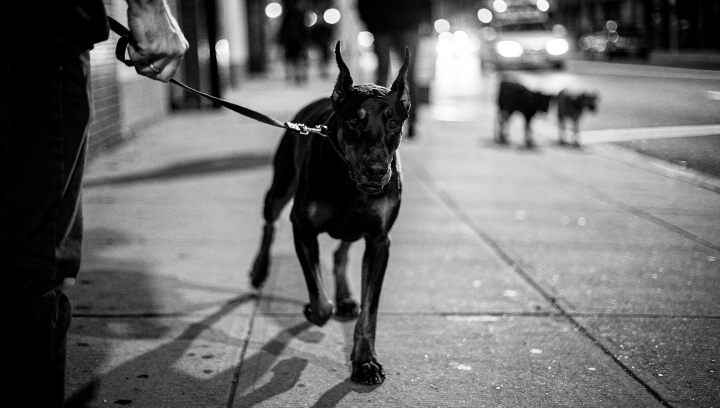
Is your Doberman lunging, barking, or acting aggressively toward other dogs, people, or triggers during walks? You’re not alone—and more importantly, you’re not stuck with this behavior forever.
Reactivity is one of the most stressful behavior problems Doberman owners face. Those once-peaceful walks turn into white-knuckle events where you’re constantly scanning for triggers, crossing streets, and feeling embarrassed by your dog’s explosive reactions.
But here’s the good news: Reactivity is manageable. With the right approach, understanding, and consistent training, you can transform your reactive Doberman into a calm, controlled companion.
In this comprehensive guide, you’ll discover:
- What reactivity really is (and why it’s not the same as aggression)
- A proven 6-step system specifically designed for reactive Dobermans
- Emergency de-escalation techniques you can use immediately
- Long-term training protocols that address root causes
- Equipment recommendations and management strategies
- When to seek professional help
Whether your Doberman is fear-reactive, barrier-frustrated, or experiences leash aggression, this guide provides practical, science-backed solutions that actually work.
Let’s transform those stressful walks into enjoyable bonding experiences.
- Understanding Reactivity in Dobermans: What’s Really Happening
- The 6-Step System to Calm Your Reactive Doberman
- Leash Reactivity vs. Off-Leash Behavior: Why the Difference?
- Should You Use a Muzzle on Your Reactive Doberman?
- Home Reactivity: Managing Window and Door Behavior
- Natural Supplements and Calming Aids
- When to Seek Professional Help
- Timeline: How Long Until You See Results?
- Common Mistakes That Make Reactivity Worse
- Success Story: From Reactive to Relaxed
- FAQ: Your Top Questions Answered
- Final Thoughts: You’ve Got This
Understanding Reactivity in Dobermans: What’s Really Happening
What is Reactivity?
Reactivity is an overreaction to environmental triggers—not true aggression. When your Doberman barks, lunges, or pulls intensely toward other dogs, people, bicycles, or other stimuli, they’re reacting from a place of:
- Fear (“That’s scary—I need to make it go away!”)
- Frustration (“I can’t get to that—this is maddening!”)
- Over-arousal (“That’s so exciting I can’t control myself!”)
- Territorial instinct (“That doesn’t belong here!”)
Most reactive Dobermans would never actually bite. They’re responding to perceived threats or overwhelming excitement with dramatic displays designed to create distance or gain access.
Is Reactivity the Same as Aggression?
No. This is a crucial distinction:
Reactivity = Overreaction driven by emotion (fear, frustration, excitement)
Aggression = Intent to cause harm
Many reactive dogs are actually fearful or anxious underneath all that barking and lunging. They’re not trying to hurt anyone—they’re trying to cope with overwhelming feelings.
That said, reactivity can escalate to aggression if not addressed, especially if a dog feels cornered or trapped.
Why Are Dobermans Prone to Reactivity?
Dobermans were bred as protection and guard dogs, which means they have:
- Natural vigilance – They’re constantly assessing their environment
- Strong protective instincts – They take their guardian role seriously
- High intelligence – They learn patterns quickly (including negative ones)
- Sensitivity – They’re highly attuned to their owner’s emotions and environmental changes
- Intense loyalty – They’re deeply bonded to their family and may be suspicious of outsiders
Without proper socialization and training, these breed traits can manifest as reactive behavior.
Common Triggers for Reactive Dobermans
- Other dogs (especially unfamiliar dogs, certain breeds, or intact males)
- Strangers approaching (particularly men, people in hats/uniforms, children)
- Bicycles, skateboards, joggers (fast-moving objects)
- Cars, motorcycles, trucks (loud vehicles)
- Other animals (squirrels, cats, wildlife)
- Barriers (fences, windows, car interiors)
- Specific locations (vet clinic, certain streets, dog parks)
Signs Your Doberman is Reactive (Not Just Excited)
Mild Reactivity:
- Intense staring or fixation
- Whining or low growling
- Pulling toward or away from trigger
- Ears forward, body tense
- Takes treats but focus wavers
Moderate Reactivity:
- Barking or growling intensely
- Lunging on leash
- Hackles raised
- Won’t take treats near trigger
- Requires significant effort to redirect
Severe Reactivity:
- Uncontrollable barking/lunging
- Snapping or air-biting
- Complete loss of impulse control
- Won’t respond to any commands
- Remains aroused long after trigger passes
The 6-Step System to Calm Your Reactive Doberman
This proven system addresses both immediate management and long-term behavior modification. Consistency is key—stick with it, and you’ll see results.
STEP 1: Understand Your Dog’s Threshold Distance
Threshold distance is the magic distance where your Doberman notices a trigger but remains calm enough to take treats and respond to commands.
- Under threshold = Calm, can focus, will take treats
- At threshold = Alert but controlled
- Over threshold = Reactive, can’t focus, won’t take treats
How to Find Your Dog’s Threshold:
- Identify a trigger (another dog, person, etc.)
- Start far away (50+ feet if needed)
- Observe your dog’s body language:
- Ears forward but relaxed?
- Body tense but not rigid?
- Can still take treats?
- Mark that distance – this is your starting training zone
Example: If your Doberman loses it at 20 feet from another dog, your threshold distance might be 40-50 feet. Training must happen at 40+ feet initially.
STEP 2: Master Counter-Conditioning
Counter-conditioning means changing your dog’s emotional response to triggers by creating positive associations.
The Protocol:
- Position yourself at threshold distance from a trigger
- The moment your dog notices the trigger, start feeding high-value treats continuously
- Keep treating as long as the trigger is visible
- Stop treating when the trigger disappears
- Repeat, repeat, repeat
The Goal: Your dog learns that trigger appearance = amazing things happen
Key Principles:
✅ Treats BEFORE reaction – Don’t wait for calm behavior; create it
✅ High-value rewards – Use chicken, cheese, liver—not regular kibble
✅ Rapid-fire delivery – Treat every 1-2 seconds while trigger is present
✅ Stay under threshold – If your dog reacts, you’re too close
✅ Be consistent – This takes 50-100+ repetitions minimum
What Success Looks Like:
Eventually, your Doberman will notice a trigger and immediately look at YOU for treats instead of reacting. This is called the “automatic check-in,” and it’s a game-changer.
STEP 3: Learn Emergency De-Escalation Techniques
Even with perfect training, surprise encounters happen. You need crisis management tools.
Emergency Technique #1: The 180-Degree Turn
When you can’t avoid a trigger:
- Say “Let’s go!” in an upbeat voice
- Immediately turn 180 degrees
- Move briskly away (jog if needed)
- Reward heavily once your dog follows
- Create as much distance as possible
Emergency Technique #2: The Barrier Block
If your dog is fixating on a trigger:
- Step directly in front of your dog (blocking their view)
- Use your body as a visual barrier
- Say “Look at me” or their name
- Reward the instant they break eye contact with trigger
- Move away quickly
Emergency Technique #3: The Emergency U-Turn
For unexpected close encounters:
- Drop a handful of treats on the ground
- While your dog sniffs/eats, turn around
- Call them enthusiastically
- Reward heavily for following
- Escape the situation
Important: These are management tools, not training solutions. Use them to avoid meltdowns while working on threshold training.
STEP 4: Gradually Decrease Distance to Triggers
Once your dog consistently shows calm behavior at threshold distance (takes treats, checks in with you, shows loose body language), you can begin decreasing distance.
The Process:
- Week 1-2: Train at 40+ feet (for example)
- Week 3-4: Move to 35 feet
- Week 5-6: Move to 30 feet
- Continue decreasing by 5-foot increments
Critical Rules:
- Go slowly – Rushing causes setbacks
- Stay at each distance until you see automatic check-ins
- Expect regression – Some days will be harder than others
- Never decrease distance if your dog is still reacting at the current one
- Celebrate small wins – This is a marathon, not a sprint
STEP 5: Practice “Engage-Disengage” Game
This powerful technique teaches your dog to notice triggers and then voluntarily look away.
How to Play:
- Set up at threshold distance from a trigger
- Wait for your dog to notice the trigger
- The moment they look at the trigger, mark it (“Yes!” or click)
- When they look back at you, treat heavily
- Repeat
What You’re Teaching:
“Looking at the trigger gets you nothing. Looking away from the trigger gets you everything.”
This builds impulse control and helps your dog learn to self-soothe.
STEP 6: Implement Daily Management Strategies
Training sessions are crucial, but daily management prevents rehearsal of reactive behavior.
Management Tools:
✅ Use a front-clip harness or Gentle Leader – Gives you better control
✅ Walk during off-peak hours – Fewer triggers = less stress
✅ Scout ahead – Survey the area before your dog sees triggers
✅ Create distance – Cross the street, use parked cars as barriers
✅ Exercise before walks – Tire your dog out to reduce arousal
✅ Practice mental stimulation – Puzzle toys, nose work, training games
✅ Control home environment – Block window access if barrier frustration is an issue
Manage Your Own Stress:
Your Doberman can sense your anxiety. When you tense up on the leash, they think:
“Mom/Dad is nervous—there must be a threat!”
Practice:
- Deep breathing before walks
- Loose leash grip
- Calm, confident body language
- Positive self-talk (“We’ve got this”)
Leash Reactivity vs. Off-Leash Behavior: Why the Difference?
Many owners notice their Doberman is reactive on leash but fine off-leash. Why?
Leash Reactivity Explained:
- Barrier frustration – The leash prevents natural fight-or-flight responses
- Feeling trapped – Dogs can’t escape, so they become defensive
- Leash tension – A tight leash signals stress down the line
- Lack of choice – Dogs feel they have no control over interactions
What This Means:
Your dog isn’t “bad”—they’re frustrated and stressed by the lack of freedom. This is why punishment makes reactivity worse: you’re punishing fear and frustration.
Should You Use a Muzzle on Your Reactive Doberman?
Short answer: Maybe, and there’s no shame in it.
When a Muzzle Makes Sense:
✅ Your Doberman has a bite history
✅ You’re working through severe reactivity
✅ You need extra safety while training
✅ Your dog shows aggressive body language (not just barking)
✅ You’re practicing in high-trigger environments
Muzzle Myths:
❌ “Muzzles are cruel” – Not when properly conditioned
❌ “Muzzles mean my dog is aggressive” – They mean you’re being responsible
❌ “Muzzles will fix reactivity” – They’re a safety tool, not a training solution
How to Muzzle Train:
- Choose a basket muzzle (allows panting, drinking, treats)
- Start with positive associations – Put treats inside muzzle
- Let your dog volunteer – Never force it on
- Build duration gradually – Wear for seconds, then minutes
- Practice at home first – Then on walks
A properly conditioned muzzle can actually reduce your stress, which helps your dog relax.
Home Reactivity: Managing Window and Door Behavior
Reactivity isn’t just a walking problem. Many Dobermans also react to:
- People passing outside windows
- Delivery drivers
- Neighbors in hallways
- Doorbells
Management Solutions:
✅ Block window access – Use furniture, curtains, or window film
✅ Desensitize to doorbells – Practice ringing it + treating
✅ Create a “safe space” – A room away from front windows/doors
✅ Use white noise – Mask outdoor sounds
✅ Practice “go to place” command – Send your dog to a mat when doorbell rings
Natural Supplements and Calming Aids
While training is essential, some reactive dogs benefit from calming supplements:
Evidence-Based Options:
- L-Theanine – Amino acid that promotes relaxation
- L-Tryptophan – Precursor to serotonin
- Chamomile – Gentle calming herb
- Valerian Root – Reduces anxiety
- CBD Oil – May reduce stress (check legality in your area)
- Adaptil (DAP) – Dog Appeasing Pheromone collar or diffuser
Important: Always consult your vet before starting supplements, especially if your dog is on other medications.
When to Seek Professional Help
You don’t have to do this alone. Seek help from a certified dog behaviorist or veterinary behaviorist if:
⚠️ Your Doberman has bitten or attempted to bite
⚠️ Reactivity is getting worse despite consistent training
⚠️ You feel unsafe or overwhelmed
⚠️ Multiple severe triggers are involved
⚠️ Your dog shows aggression in the home
⚠️ You’ve been working for 3+ months with no improvement
How to Find a Professional:
- Certified Applied Animal Behaviorist (CAAB): CAAB Directory
- Veterinary Behaviorist (DACVB): Board-certified veterinarian specializing in behavior
- Certified Professional Dog Trainer (CPDT-KA): With reactivity experience
Avoid trainers who use punishment, prong collars, or “dominance” methods. These worsen reactivity.
Timeline: How Long Until You See Results?
Realistic Expectations:
Weeks 1-2:
- You’ll start to identify patterns and triggers
- Your dog may still react frequently
- Focus on staying under threshold
Weeks 3-4:
- You’ll notice occasional automatic check-ins
- Distance from triggers may decrease slightly
- Management becomes easier
Weeks 5-8:
- Consistent improvement at threshold distance
- Your dog may show calm behavior with familiar triggers
- You can begin decreasing distance
Months 3-4:
- Significant progress with known triggers
- Fewer explosive reactions
- Improved overall calmness
Months 6-12:
- Your dog may be manageable in most situations
- Some triggers may remain challenging
- Continued practice maintains gains
Remember: Severe reactivity may take 12-18 months. Progress isn’t linear. Celebrate small victories.
Common Mistakes That Make Reactivity Worse
❌ Punishing reactive behavior – Increases fear and stress
❌ Forcing interactions – “Just let them sniff!” makes things worse
❌ Training over threshold – Your dog can’t learn when panicked
❌ Inconsistent practice – Reactivity training needs daily work
❌ Tensing up on the leash – Signals to your dog that danger is near
❌ Avoiding all triggers forever – Management alone won’t fix reactivity
❌ Expecting quick fixes – Behavior change takes time
Success Story: From Reactive to Relaxed
Meet Max, a 3-year-old Doberman:
Max was so reactive to other dogs that walks were impossible. His owner couldn’t get within 100 feet of another dog without Max losing his mind—barking, lunging, and pulling with all his strength.
What Changed:
- Week 1-2: Identified Max’s threshold (60 feet from other dogs)
- Week 3-6: Practiced counter-conditioning daily at 60 feet
- Week 7-10: Gradually decreased to 40 feet
- Month 3: First successful pass at 20 feet without reacting
- Month 6: Max could walk within 10 feet of calm dogs
Today: Max still has triggers (fast-moving dogs, off-leash dogs), but 90% of walks are enjoyable. His owner says: “It’s not perfect, but it’s night and day from where we started.”
FAQ: Your Top Questions Answered
1. Is reactivity the same as aggression in Dobermans?
No. Reactivity is an overreaction to environmental triggers driven by fear, frustration, or over-arousal. Aggression involves intent to harm. Many reactive Dobermans would never actually bite.
2. How long does it take to calm a reactive Doberman?
Mild reactivity: 4-8 weeks
Moderate: 2-4 months
Severe: 6-12+ months
Consistency is the biggest factor.
3. What is threshold distance and why does it matter?
Threshold distance is where your dog notices a trigger but remains calm enough to take treats and respond to commands. Training must happen under threshold for counter-conditioning to work.
4. Should I use a muzzle on my reactive Doberman?
If your dog has a bite history, shows severe aggression, or you need extra safety while training, a properly fitted basket muzzle is a responsible tool. It doesn’t fix reactivity but provides safety.
5. Can I train my reactive Doberman myself or do I need a professional?
Many mild to moderate cases can be managed with owner-led training. Seek professional help if your dog has bitten, reactivity is worsening, or you feel unsafe.
6. What are the best treats for reactive dog training?
High-value treats like small pieces of real chicken, turkey, cheese, freeze-dried liver, or hot dog. They should be more exciting than regular food.
7. Will more exercise fix my Doberman’s reactivity?
Exercise is important, but it won’t fix reactivity alone. Over-exercising without addressing triggers can increase arousal and worsen reactions.
8. Is punishment effective for reactive behavior?
No. Punishment typically worsens reactivity by increasing fear and stress. You can’t punish a dog out of fear.
9. Why is my Doberman reactive on leash but not off leash?
This is called leash reactivity or barrier frustration. On leash, dogs feel restrained and unable to escape, leading to increased defensive behavior.
10. Can medication help with my reactive Doberman?
In severe cases, anti-anxiety medication prescribed by a veterinary behaviorist can help reduce stress enough for training to be effective. Always combine medication with behavior modification.
Final Thoughts: You’ve Got This
Living with a reactive Doberman is challenging—but it’s not hopeless. With patience, consistency, and the right approach, you can transform your walks from stressful battles into enjoyable bonding time.
Remember:
✅ Reactivity is manageable
✅ Progress takes time (and that’s okay)
✅ Small victories matter
✅ Your dog isn’t “bad”—they’re struggling
✅ You’re not alone—many Doberman owners face this
✅ Professional help is available if you need it
Start with Step 1 today: find your dog’s threshold distance. Take it one walk at a time, celebrate every automatic check-in, and be patient with yourself and your Doberman.
You’re already taking the first step by reading this guide. That shows you’re committed to helping your dog succeed.
Now get out there and transform that reactivity—one treat at a time.