Affiliate Disclosure: Some of the links in this post are affiliate links. This means we may earn a small commission if you make a purchase through these links—at no extra cost to you. We only recommend products and tools that we genuinely believe will help you with your Doberman.
Your 8-week-old Doberman puppy just arrived home, and you’re staring at this adorable bundle of energy wondering: where do I even start? You’ve heard that Dobermans are smart, loyal, and protective—but you’ve also heard they can be stubborn, intense, and challenging if not trained properly.
Here’s the truth: the next 12 weeks will shape your Doberman’s personality for life. What you teach (or don’t teach) during these critical early weeks determines whether you’ll have a well-mannered companion or a 90-pound handful at one year old.
This guide gives you a clear, week-by-week roadmap for training your Doberman puppy from 8 to 20 weeks old. No confusing jargon. No overwhelming lists. Just practical, proven training steps that work specifically for this unique breed.
Let’s get started.
- Why Early Training is Critical for Doberman Puppies
- Understanding Your Doberman Puppy’s Brain
- Before You Start: Essential Setup
- Week-by-Week Training Timeline (8-20 Weeks)
- Essential Commands Broken Down (Step-by-Step)
- Critical Behavior Training Areas
- Socialization: The Make-or-Break Period
- Troubleshooting Common Early Training Problems
- Training Mistakes That Damage Your Doberman
- Setting Your Puppy Up for Long-Term Success
Why Early Training is Critical for Doberman Puppies
The Doberman Difference: Why This Breed Needs an Early Start
Dobermans aren’t like other dogs. They’re ranked as the 5th smartest dog breed in the world—right behind Border Collies, Poodles, German Shepherds, and Golden Retrievers. That intelligence is both a gift and a challenge.
Smart dogs learn fast. That means your Doberman puppy will pick up good habits quickly—but they’ll also learn bad habits just as fast. If you accidentally reward jumping, barking, or pulling on the leash early on, those behaviors become deeply ingrained.
Dobermans are also incredibly sensitive. They read your emotions like a book. If you’re frustrated during training, they feel it. If you’re inconsistent with rules, they notice. This emotional awareness means harsh corrections damage their trust, but positive training builds an unbreakable bond.
Finally, Dobermans are natural protectors. Even as puppies, they’re watching everything. Without proper early socialization, that protectiveness can turn into fearfulness or aggression toward strangers, other dogs, or new situations.
Critical Windows You Can’t Get Back
Your puppy’s brain is developing rapidly right now. Scientists have identified specific “windows” when certain types of learning happen most easily:
The Socialization Window (3-14 weeks): This is the period when your puppy’s brain is wide open to new experiences. Puppies exposed to lots of people, places, and positive experiences during this time grow into confident adult dogs. Miss this window, and you may struggle with fear or aggression issues for years.
The Primary Learning Period (8-16 weeks): Your puppy is a sponge right now. Basic commands, house rules, and routines sink in easily. Training feels almost effortless because your puppy WANTS to learn and please you.
The Fear Imprint Stage (8-10 weeks, then again at 16-20 weeks): During these periods, scary experiences leave lasting impressions. A bad encounter at the vet or a frightening dog interaction can create lifelong fears. You need to be extra careful to keep experiences positive during these weeks.
What This Guide Covers
This article walks you through exactly what to teach your Doberman puppy each week from 8 to 20 weeks old. You’ll learn:
- Which commands to start with (and which to wait on)
- How long training sessions should be at each age
- Common problems you’ll face—and how to solve them
- The biggest mistakes new Doberman owners make
- Realistic expectations for when your puppy will be “trained”
Think of this as your training roadmap. Follow it step-by-step, and by 20 weeks old, you’ll have a puppy with a solid foundation for a lifetime of good behavior.
Understanding Your Doberman Puppy’s Brain
How Dobermans Learn Differently
Ever notice how your Doberman puppy stares at your face constantly? That’s not just cute—it’s how they learn.
Dobermans are visual learners. They pay close attention to your body language, facial expressions, and hand movements. This is why hand signals work so well with this breed. In fact, many Doberman trainers teach hand signals BEFORE verbal commands.
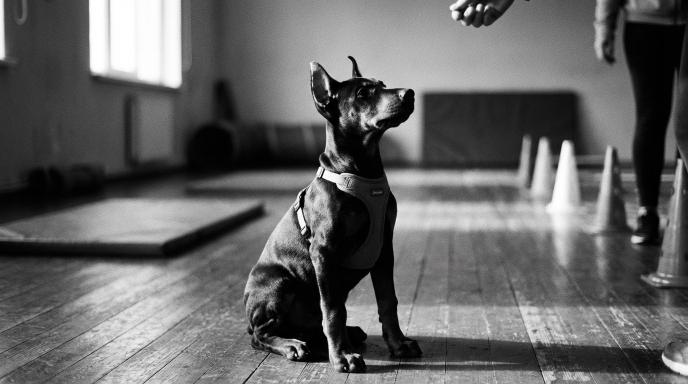
Try this: hold a treat above your puppy’s head and slowly move it backward over their head. They’ll naturally sit to keep watching the treat. You just used their visual learning style to teach “sit” without saying a word.
Dobermans are also emotionally intelligent. They sense your mood before you even speak. If you’re stressed, they get anxious. If you’re excited, they get hyper. This emotional connection is beautiful—it’s what makes Dobermans such loyal companions. But it also means your energy during training matters more than your words.
Finally, Dobermans are problem-solvers. They don’t just follow commands blindly—they think about WHY you’re asking. This intelligence means they can figure out complex tricks easily. But it also means they’ll find creative ways around rules if your training isn’t consistent.
Temperament Traits That Impact Training
Dobermans are famous “Velcro dogs.” Your puppy wants to be near you ALL the time. They’ll follow you from room to room, sleep at your feet, and panic when you leave. This closeness makes training easier (they’re always watching you), but it also means you need to actively teach independence to prevent separation anxiety.
Your Doberman puppy is also naturally alert. They notice every sound, every movement, every visitor. This vigilance will make them excellent watchdogs as adults, but as puppies, it can lead to excessive barking if you don’t channel it properly.
Finally, protective instincts start showing up early—sometimes as young as 12-16 weeks. Your puppy might bark at strangers approaching you or position themselves between you and unfamiliar people. This isn’t aggression (yet)—it’s normal Doberman behavior. But without proper socialization, it can escalate.
The “Soft” vs. “Hard” Doberman Personality
Not all Dobermans are the same. Some puppies are confident, bold, and resilient (“hard” temperament). Others are sensitive, cautious, and easily overwhelmed (“soft” temperament).
How do you tell the difference?
A hard Doberman puppy recovers quickly from corrections, isn’t bothered by loud noises, explores new environments confidently, and may challenge your rules. These puppies need firm (but never harsh) boundaries and consistent leadership.
A soft Doberman puppy is more hesitant in new situations, shuts down if corrected too firmly, seeks reassurance frequently, and may be startled by sudden sounds. These puppies need gentle encouragement, patience, and lots of positive reinforcement.
Most Dobermans fall somewhere in the middle. Watch your puppy closely during the first few weeks home. Their personality will tell you how to adjust your training approach.
Before You Start: Essential Setup
Training Supply Checklist
Before your first training session, gather these supplies:
Collar and Harness: For an 8-week-old Doberman puppy, start with a lightweight adjustable collar (8-12 inches) for ID tags. For leash training, use a front-clip harness to prevent pulling without putting pressure on their developing neck.
High-Value Treats: “High-value” means treats your puppy goes CRAZY for—not their regular kibble. Small, soft treats work best because your puppy can eat them quickly and get back to training. Cut them into pea-sized pieces. You’ll use 20-30 treats per training session.
Treat Pouch: Wear a treat pouch on your belt so rewards are always ready. Fumbling in your pocket wastes precious seconds when training a puppy with a 10-second attention span.
Crate: Choose a crate that will fit your adult Doberman (42-48 inches long) and use a divider panel to adjust the space as they grow. The crate should be large enough for your puppy to stand, turn around, and lie down—but not so large they can potty in one corner and sleep in another.
Leash: Start with a lightweight 4-6 foot leash. Avoid retractable leashes—they teach pulling, not loose-leash walking.
Setting Up Your Home for Success
Puppy-proof before your Doberman arrives. Get down on your hands and knees and look around. What could a curious puppy chew? Hide electrical cords, move houseplants out of reach, remove shoes and kids’ toys from the floor.
Create a “training zone” in your home—a low-distraction area where you’ll practice commands. The kitchen often works well because you can close doors to limit distractions and the floor is easy to clean.
Set up your puppy’s crate in a busy area (like your bedroom at night, living room during the day) so they don’t feel isolated. Dobermans are social dogs—they need to be near their family even when resting.
Establishing Your Role as Leader
Dobermans are pack animals. They need a leader—someone who sets clear rules, provides direction, and makes them feel safe.
But leadership doesn’t mean dominance. You don’t need to “alpha roll” your puppy or eat before them or walk through doors first (these outdated methods actually damage trust with sensitive Dobermans).
Instead, establish leadership through consistency and calmness:
- Feed meals at the same times every day (you control resources)
- Require a sit before putting the food bowl down (nothing is free)
- Teach “wait” at doorways (you make decisions about safety)
- End play sessions before your puppy wants to stop (you set boundaries)
These small daily interactions teach your Doberman that you’re a calm, reliable leader worth following.
Week-by-Week Training Timeline (8-20 Weeks)
Weeks 8-10: Foundation Phase (First 2 Weeks Home)
What to Teach:
Your first priority is building trust and establishing a routine. Your puppy just left their mother and littermates—everything is new and scary.
Start with name recognition. Say your puppy’s name in a happy, upbeat voice. When they look at you, immediately praise and give a treat. Repeat this 10-15 times daily. Within 3-4 days, your puppy should whip their head around every time you say their name.
Crate training begins now. Make the crate a happy place by feeding all meals inside it, tossing treats in randomly throughout the day, and giving special chew toys only in the crate. Never force your puppy inside or use the crate as punishment.
Potty training starts immediately. Take your puppy outside every 1-2 hours: right after waking up, after eating, after playtime, and before bed. Stand in one specific spot, say “go potty” in a calm voice, and wait. When they go, celebrate like they just won an Olympic medal—jump up and down, give three treats, tell them they’re the best puppy in the world.
Gentle handling is critical now. Touch your puppy’s ears, paws, tail, and mouth daily while giving treats. This prepares them for grooming, vet visits, and nail trims. Dobermans with cropped ears need extra gentle handling around their bandages during healing.
Training Duration: Keep sessions SHORT—5 minutes maximum, 3-4 times daily. Your puppy’s attention span is tiny right now.
Common Challenges: Crying at night (place the crate next to your bed so they hear you breathing), frequent accidents (stick to the schedule!), and mouthing your hands (redirect to a toy every single time).
Milestone: By week 10, your puppy should respond when you say their name, willingly enter the crate for meals, and have fewer potty accidents.
Weeks 10-12: Basic Commands Begin
What to Teach:
Now you’re ready for real obedience training. Start with Sit—the easiest and most useful command.
Hold a treat at your puppy’s nose, then slowly lift it up and back over their head. As their nose goes up, their rear end naturally drops down. The second their butt hits the floor, say “Yes!” and give the treat. Repeat 5-10 times per session.
After 2-3 days, add the word “Sit” right before you move the treat. After another 2-3 days, add a hand signal—hold your palm flat facing up, then lift it upward. Soon your puppy will sit from the hand signal alone.
Come (recall) training starts as a game. Sit on the floor with treats. Let your puppy wander a few feet away, then say their name followed by “Come!” in an excited voice. Pat the floor, make kissing noises—make it irresistible. When they run to you, give THREE treats and tons of praise. Never call your puppy to you for something unpleasant (like ending playtime or giving a bath).
Touch training (also called targeting) teaches your puppy to touch their nose to your hand. Hold your palm flat near their face. Most puppies naturally sniff it. The instant their nose touches your hand, say “Yes!” and treat. This simple command becomes incredibly useful—you can guide your puppy away from distractions, call them to you, and redirect unwanted behavior.
Leash introduction happens now, but don’t go on walks yet. Just let your puppy wear a harness around the house for 5-10 minutes daily while supervised. Toss treats and play so they associate the harness with fun.
Training Duration: Increase to 5-10 minute sessions, 4-5 times daily. Training should still feel like a fun game.
Socialization Priority: Enroll in a puppy training class starting at 10-12 weeks. Choose a class that requires proof of vaccinations and keeps puppies separated during play (prevents overwhelming shy puppies). Also arrange “meet and greets” with vaccinated, friendly adult dogs who can model calm behavior.
Milestone: By week 12, your puppy should sit on command 70% of the time, come when called indoors, and accept wearing a harness.
Weeks 12-14: Socialization Peak
THIS IS THE MOST IMPORTANT TWO-WEEK PERIOD IN YOUR PUPPY’S LIFE.
Your puppy’s socialization window is closing. By 14-16 weeks, their brain becomes less flexible. New experiences after this age can trigger fear instead of curiosity.
Your mission: expose your puppy to 100+ different people and 50+ different experiences before 14 weeks old. Veterinary behaviorists actually recommend this—it’s not an exaggeration.
What to Teach:
Continue practicing sit and come, but now add Down. From a sit, hold a treat at your puppy’s nose and slowly lower it straight down to the floor, then pull it slightly forward (creating an “L” shape). Your puppy should follow the treat into a lying position. The second their elbows hit the ground, give the treat.
Down is harder than sit because it’s a vulnerable position—Dobermans especially resist it at first. Be patient. Reward even small steps, like lowering their head halfway.
Stay starts as a 3-5 second exercise. Ask your puppy to sit, hold your palm in front of their nose (like a “stop” signal), and count to three in your head. Before they move, say “Okay!” (your release word) and toss a treat. Gradually increase to 10 seconds.
Leave It teaches impulse control—one of the most important skills for a strong-willed Doberman. Hold a treat in your closed fist. Your puppy will sniff, lick, and paw at your hand. Ignore all of it. The moment they pull their nose away from your hand (even for half a second), say “Yes!” and give a treat from your OTHER hand. Repeat until your puppy immediately backs away from your closed fist. Then progress to leaving a treat on the floor (covered by your hand at first).
Loose-leash walking begins in your yard or quiet street. The rule is simple: the leash has slack = we move forward. The leash is tight = we stop. Every time your puppy pulls, freeze like a statue. Wait until they glance back at you or the leash loosens, then continue walking. This teaches that pulling gets them nowhere, but walking beside you gets them where they want to go.
Socialization—Your Top Priority:
Take your puppy EVERYWHERE (but avoid high-traffic dog areas like dog parks where unvaccinated dogs might go). Bring treats and make every new experience positive:
- Hardware stores (cart rides, meet employees)
- Pet-friendly stores (Petco, Home Depot)
- Outdoor patios at cafes
- Parking lots (watch carts, people coming/going)
- Near playgrounds (kids laughing, screaming)
- Veterinary clinic (go inside just to get treats from staff, then leave—no scary exam!)
Introduce your puppy to:
- People of different ages (babies, toddlers, teens, elderly)
- People of different ethnicities
- People wearing hats, sunglasses, uniforms, helmets
- People using canes, wheelchairs, walkers
- Men with beards
- People carrying umbrellas or large bags
Have each person give your puppy a treat (if your puppy is comfortable—never force interactions).
Sound Desensitization: Play YouTube videos of thunder, fireworks, vacuum cleaners, and sirens at low volume while your puppy eats meals. Gradually increase volume over days.
Training Duration: Still 10-15 minutes per formal session, but socialization happens all day long.
Milestone: By week 14, your puppy should be comfortable being handled by strangers, relaxed in new environments, and responding to basic commands even with mild distractions.
Weeks 14-16: Building Duration
What to Teach:
Your puppy has the basics down. Now you make them stronger.
Longer Stays: Increase stay duration to 15-20 seconds. Add distance—take one step back, then two, then three. If your puppy breaks the stay, don’t get frustrated. Just calmly guide them back to position and reduce the difficulty (shorter time or closer distance).
Wait Command: This is different from stay. “Stay” means don’t move until I release you. “Wait” means pause for a moment, then you can proceed. Use “wait” at doorways, before getting out of the car, and before eating meals. It teaches patience and impulse control.
Drop It: This command prevents resource guarding and saves you from constant toy tug-of-war battles. During playtime, trade your puppy’s toy for a treat. Say “Drop it,” show the treat, and the moment they release the toy, give the treat AND give the toy back. They learn that dropping something isn’t losing it—it’s a way to get rewards.
Polite Greetings (No Jumping): Doberman puppies are enthusiastic greeters. Those jumping paws are cute now but painful when they’re 70 pounds. Teach this: when someone approaches, ask your puppy to sit. Visitors only pet if all four paws stay on the ground. The moment your puppy jumps, visitors turn away and ignore them. Repeat until jumping doesn’t work.
Training Duration: 10-15 minute sessions remain ideal. Your puppy’s attention span is growing, but they still get mentally tired quickly.
Common Challenges: Teething intensifies between 14-20 weeks. Your puppy’s mouth hurts, so they chew EVERYTHING. Provide frozen washcloths, rubber chew toys, and bully sticks. When they bite you, immediately yelp loudly (like a puppy would) and stop playing for 30 seconds. This teaches bite inhibition.
Distraction levels are also climbing. Your puppy notices other dogs, squirrels, cars—everything is more interesting than you. Practice commands in busier locations gradually.
Milestone: By week 16, your puppy should have reliable basic commands in low-distraction environments and understand that good behavior (sitting, waiting) gets rewarded.
Weeks 16-20: Proofing and Real-World Practice
What to Teach:
“Proofing” means testing commands in distracting environments. Can your puppy sit when another dog is nearby? Come when squirrels are running? Stay when kids are playing?
Practice commands:
- At the park (but not off-leash yet)
- During walks in the neighborhood
- When visitors arrive at your home
- Around other dogs (at a distance at first)
Public Loose-Leash Walking: Now your puppy should walk on a loose leash for 10-15 minute neighborhood walks. Bring high-value treats and reward every 20-30 steps of loose-leash walking at first. Gradually space out rewards.
Settle/Relax on Cue: Teach your Doberman to calm down on command. Place a mat or towel on the floor. Lure your puppy onto it with a treat, then give them a long-lasting chew (like a bully stick). Pet them slowly and say “settle” in a calm, low voice. Practice daily. Eventually, “settle” becomes a cue to relax, which helps during vet visits, grooming, and when guests visit.
Emergency Recall Foundation: This is a separate command from “come”—one you’ll only use in life-threatening situations (your puppy slips their collar near traffic). Choose a unique word (“EMERGENCY!” or use a whistle). Every single time you use this command, give a JACKPOT reward—an entire handful of treats or a special toy they never get otherwise. Practice once per week in a safe, enclosed area.
Training Duration: Sessions can increase to 15-20 minutes now, but watch for signs your puppy is mentally tired (yawning, looking away, lying down).
Common Challenges: Welcome to the “teenage bratty phase.” Around 16-20 weeks, many Doberman puppies suddenly seem to “forget” everything they learned. They ignore commands, test boundaries, and act stubborn. This is NORMAL—it’s like a human teenager rolling their eyes. Stay consistent. Don’t give up. This phase passes.
You’ll also notice a second fear period around 16-20 weeks. Your puppy might suddenly act scared of things that never bothered them before (a trash can, a statue, a loud truck). Don’t coddle them, but don’t force them to approach scary things either. Just stay calm, reward brave behavior, and keep moving.
Milestone: By week 20, your puppy should respond to basic commands outdoors with mild to moderate distractions, walk politely on a leash most of the time, and have a solid foundation for continued training.
Essential Commands Broken Down (Step-by-Step)
Sit: The Gateway Command
Why start with sit? Because it’s easy for your puppy to perform, and it becomes a default behavior you’ll use hundreds of times: before meals, at doorways, when greeting people, before playing fetch—sit is the Swiss Army knife of dog training.
The Lure Method:
- Hold a treat between your thumb and fingers at your puppy’s nose level
- Slowly lift the treat straight up and slightly back over your puppy’s head (imagine drawing a gentle arc)
- Your puppy’s nose will follow the treat upward, which naturally causes their rear to lower
- The instant their bottom touches the ground, say “Yes!” and release the treat
- Repeat 5 times in a row, then take a 2-minute break
Adding the Verbal Cue (after 2-3 days):
Once your puppy is reliably following the treat into a sit, add the word “Sit” right BEFORE you move the treat. Say it once, clearly: “Sit.” Then move the treat as usual.
Adding the Hand Signal (after 5-7 days):
Dobermans are visual learners. Hand signals often work better than words. Use this signal: hold your palm flat facing upward, then lift your hand upward (like you’re motioning “come up here”). Practice the hand signal without the treat lure—your puppy should sit from the hand signal alone within a few days.
Common Mistakes:
- Puppy jumps up instead of sitting: You’re holding the treat too high or too far forward. Keep it closer to their nose and move it straight up.
- Puppy backs up: You’re moving the treat too far back. Adjust the angle.
- You say “sit” multiple times: Only say it once. If your puppy doesn’t respond, guide them with the treat lure. Repeating the command teaches them to ignore the first few times you say it.
Come: The Life-Saving Skill
A reliable recall could literally save your Doberman’s life one day—if they slip their collar near traffic, escape through an open gate, or chase a squirrel toward danger.
The Golden Rules of Recall Training:
- NEVER call your puppy to you for something unpleasant (bath time, nail trims, ending play). If you need to do something they dislike, go get them—don’t call them.
- Always reward generously—every single time they come, give 3-5 treats in a row and tons of praise, even if they took their sweet time.
- Never punish after recall—if your puppy runs away, comes back 10 minutes later, and you’re furious, DO NOT scold them. From their perspective, they came when called and got punished. That’s how you ruin a recall forever.
The Training Method:
- Start indoors with zero distractions
- Have a handful of high-value treats ready
- Wait until your puppy is a few feet away (but still in the same room)
- Say their name to get attention, then “Come!” in a happy, excited voice
- Clap your hands, pat your legs, make kissy noises—be irresistible
- When they reach you, give 3-5 treats one at a time while praising
- Release them to play again (so coming to you doesn’t mean the fun ends)
Progressing to Outdoors:
Once your puppy comes reliably indoors, practice in your fenced yard. Use a long line (a 15-20 foot lightweight leash) so your puppy can’t ignore you and run away. If they don’t come immediately, gently reel in the long line while calling them, then reward when they reach you.
Down: The Calm Command
Down puts your puppy in a submissive, relaxed position. It’s harder to teach than sit because dogs feel vulnerable lying down—they can’t run away as quickly if needed. Dobermans, with their guardian instincts, sometimes resist this command more than other breeds.
The Training Method:
- Start with your puppy in a sit position
- Hold a treat at their nose
- Slowly lower the treat straight down to the floor between their front paws
- Keep the treat there—don’t pull it away
- Your puppy should lower their head to follow the treat
- If their elbows touch the ground, JACKPOT—give 3 treats and celebrate
- If they stand up instead, lure them back into a sit and try again
Making It Easier:
Some puppies just don’t get it at first. Try these tricks:
- Sit on the floor with one leg bent. Lure your puppy under your leg—they have to lie down to fit under it
- Capture natural downs—when your puppy lies down on their own, immediately say “Down!” and give a treat
- Reward partial efforts—if they lower their chest even a little, reward that small step
Why Dobermans Resist:
Your Doberman puppy isn’t being stubborn—they’re being cautious. In dog language, lying down signals submission or vulnerability. Forcing the issue damages trust. Be patient. Some Dobermans take 2-3 weeks to feel comfortable with this command.
Stay: Impulse Control Foundation
Stay teaches your Doberman self-control—the ability to resist impulses. This skill prevents door-darting, counter-surfing, and jumping on guests.
The Three D’s of Stay:
- Duration: How long they stay
- Distance: How far you move away
- Distraction: What’s happening around them
Train each “D” separately at first. Don’t increase difficulty on more than one at a time.
The Training Method (Duration):
- Ask your puppy to sit
- Hold your palm flat in front of their nose (like a “stop” signal)
- Count “1, 2, 3” in your head
- Before they move, say “Okay!” (release word) and toss a treat
- Gradually increase to 5, 10, then 15 seconds
Adding Distance:
- Once your puppy can stay for 15 seconds with you right in front of them, take ONE step backward
- Immediately step back forward and release them
- Gradually add more steps: 2 steps back, 3 steps, 5 steps, across the room
Common Mistakes:
- Releasing your puppy by saying their name: This confuses recall training. Use a separate release word like “Okay” or “Free.”
- Letting your puppy “break” the stay without consequences: If they get up early, calmly guide them back to position without giving the treat. Try again with reduced difficulty.
- Making eyes contact: Staring directly at your puppy creates pressure that makes them want to move. Instead, look at their chest or shoulder.
Leave It: The Safety Command
“Leave it” means “ignore that thing and focus on me.” This command stops your puppy from picking up chicken bones on sidewalks, eating trash, or grabbing your shoe.
The Training Method:
- Hold a low-value treat (piece of kibble) in your closed fist
- Let your puppy sniff, lick, and paw at your hand—completely ignore all of it
- The instant they pull their nose away (even for half a second), say “Yes!” and give a HIGH-VALUE treat from your other hand
- Repeat 10 times
- Your puppy will learn: ignoring the boring treat gets me a better treat
Progression Levels:
- Level 1: Treat in closed fist
- Level 2: Treat in open palm
- Level 3: Treat on the floor, covered by your hand
- Level 4: Treat on the floor, hand hovering over it
- Level 5: Treat on the floor, you standing up
- Level 6: Treat on the floor during a walk
Move to the next level only when your puppy succeeds 10 times in a row at the current level.
Real-World Application:
Practice “leave it” with tempting items: your shoe, a toy, dropped food. The command should mean “don’t touch that, no matter how much you want it.”
Critical Behavior Training Areas
Potty Training Success Formula
Potty training is 90% management, 10% training. Here’s the truth: puppies don’t have accidents because they’re stubborn—they have accidents because their tiny bladders can only hold so much, and they don’t yet understand where it’s acceptable to go.
The Schedule Method:
Take your 8-12 week old puppy outside every 1-2 hours, PLUS:
- Immediately after waking up (even from short naps)
- Within 5-10 minutes after eating
- After play sessions
- Right before bed
Set a timer on your phone if needed.
The Process:
- Carry your puppy outside to the same spot every time (they’re triggered by the scent of previous potties)
- Stand still and boring—no play, no talking
- Say your cue phrase: “Go potty” in a calm voice
- Wait. This might take 5-10 minutes. Be patient.
- The INSTANT they start to go, say “Yes!” quietly (don’t interrupt)
- When they finish, throw a party—give 3 treats, praise, play a quick game
Crate Training Connection:
Dogs naturally don’t want to soil their sleeping area. A properly sized crate (just big enough to stand, turn, and lie down) encourages your puppy to “hold it” overnight and during short alone periods.
At 8-10 weeks: Expect 1-2 middle-of-the-night potty breaks
At 10-12 weeks: Many puppies can hold it for 4-5 hours overnight
At 12-16 weeks: Most can sleep 6-7 hours without a break
At 16-20 weeks: Bladder control improves; accidents become rare
When Accidents Happen:
If you catch your puppy mid-accident, clap your hands once (to interrupt), then quickly carry them outside to finish. Reward when they go outside.
If you find an accident later, don’t react. Your puppy won’t connect your anger to something they did 20 minutes ago. Just clean it thoroughly with an enzymatic cleaner (not ammonia-based—ammonia smells like urine to dogs and attracts them back to the same spot).
Realistic Timeline:
Most Doberman puppies are reliably housetrained by 4-6 months old. Some learn faster, some take longer. Occasional accidents are normal until 10-12 months.
Bite Inhibition Training
All puppies bite. They explore the world with their mouths, they play-bite with littermates, and their gums hurt from teething.
Your job isn’t to stop biting completely (that’s impossible with a puppy)—it’s to teach bite inhibition, which means your Doberman learns to control the pressure of their bite.
Why This Matters:
An adult dog with good bite inhibition who accidentally bites (perhaps startled or stepped on) will quickly release and barely break skin. A dog who never learned bite inhibition might seriously injure someone in that same situation.
The Yelp and Redirect Method:
- When your puppy bites your hand during play, immediately yelp loudly—”OW!”—in a high-pitched voice (like a puppy would)
- Let your hand go limp and stop playing for 10-15 seconds
- Turn away from your puppy (removing your attention)
- If they stop biting, resume play
- If they bite again, yelp and leave the room for 30 seconds
Your puppy learns: biting too hard = fun stops immediately.
Redirecting to Appropriate Items:
Always have a toy nearby. When your puppy mouths your hand, immediately stuff a toy in their mouth instead. Praise them for chewing the toy.
Keep appropriate chew items available constantly: rubber Kong toys, rope toys, bully sticks, frozen washcloths (for teething pain).
What NOT to Do:
- Never hit, slap, or tap your puppy’s nose—this damages trust and can actually make biting worse (they might become defensive)
- Don’t roughhouse with hands—use toys for play, not your hands
- Don’t pull your hand away quickly—this triggers prey drive and makes biting more exciting
Timeline:
Most Doberman puppies develop a “soft mouth” by 16-18 weeks if you’re consistent with bite inhibition training. By 6 months, mouthing should be minimal or completely stopped.
Crate Training Without Trauma
Done right, crate training gives your puppy a safe den where they feel secure. Done wrong, it becomes a prison they fear and resent.
Positive Association Techniques:
- Feed ALL meals inside the crate for the first 2-3 weeks
- Toss treats into the crate randomly throughout the day (puppy wanders in, finds a surprise)
- Give special high-value chews ONLY in the crate (frozen Kong stuffed with peanut butter, bully sticks)
- Never force your puppy inside—lure them in with treats
- Leave the door open during the day so they can choose to nap inside
The First Night:
Place the crate right next to your bed—close enough that you can dangle your fingers through the bars if your puppy whimpers.
When your puppy cries:
- Wait 30-60 seconds—see if they self-soothe
- If crying continues, place your hand near the crate so they smell you
- If crying becomes frantic, they might need a potty break (puppies 8-12 weeks usually need one middle-of-the-night break)
- Take them out calmly—no playing, no talking. Potty break only. Then back in the crate.
Night Crying Protocol:
- Don’t rush to the crate the instant your puppy makes a sound—you’ll teach them that crying summons you
- Do respond if they’re truly panicked or need a bathroom break
- Do provide a stuffed animal or ticking clock in the crate—the heartbeat-like rhythm is comforting
- Don’t let them out when they’re crying—wait until they’re quiet for at least 10 seconds, then open the door
Gradual Alone Time Building:
- Week 1: Crate with door closed while you’re in the room (5-10 minutes)
- Week 2: Crate while you leave the room but stay in the house (10-20 minutes)
- Week 3: Crate while you step outside briefly (5-15 minutes)
- Week 4+: Gradually increase to 2-3 hours (maximum for a young puppy)
Preventing Separation Anxiety
Dobermans are Velcro dogs—they LOVE being with you. But that intense attachment can become separation anxiety if you’re not careful.
Early Independence Exercises:
- From day one, practice leaving your puppy in a safe area (crate or playpen) while you’re still home
- Don’t make a big deal of arrivals and departures—no dramatic hellos or goodbyes
- Teach your puppy that alone time is normal and temporary
Exercise Before Alone Time:
A tired puppy is a calm puppy. Before you leave, take your puppy for a walk or play session. Mental exercise (training, puzzle toys) is even more tiring than physical exercise.
Create a “Departure Routine”:
Do the same sequence before every departure: give a special chew toy, say “I’ll be back,” and leave calmly. Your puppy learns to predict alone time and relax.
Avoid Velcro Dog Syndrome:
- Don’t let your puppy follow you everywhere—practice “stay” when you go to another room
- Ignore attention-seeking behavior (pawing, whining for pets)—only give attention when your puppy is calm
- Teach “settle” on a mat across the room while you watch TV
Socialization: The Make-or-Break Period
Critical Socialization Window (3-14 Weeks)
Between 3 and 14 weeks old, your puppy’s brain is incredibly flexible. New experiences are exciting rather than scary. This is nature’s way of preparing puppies to adapt to their environment.
But around 14-16 weeks, that window starts closing. The brain shifts from “learn about the world” mode to “be cautious about unfamiliar things” mode. This developmental stage helps adult dogs survive in the wild (unfamiliar = potential danger).
The consequence: Puppies who aren’t properly socialized by 14 weeks are at much higher risk of developing fear-based aggression, anxiety, and reactivity toward people, dogs, and new situations.
The 100-Person Challenge
Veterinary behaviorists recommend that puppies meet 100+ different people before 14 weeks old. That sounds overwhelming, but it’s achievable:
- Invite friends and family over (groups of 3-5 people = faster progress)
- Take your puppy to pet-friendly stores
- Sit on a bench outside a grocery store (people walking by will want to pet your cute puppy)
- Visit outdoor patios at restaurants
- Go to your kid’s soccer practice
Types of People to Include:
- Babies and toddlers (supervised—teach your puppy to be gentle)
- Children of all ages
- Teenagers (they move differently than adults)
- Elderly people (slower movement, sometimes with assistive devices)
- People of different ethnicities
- Men with beards
- People wearing hats, sunglasses, hoodies
- People in uniforms (mail carriers, police, delivery drivers)
- People using wheelchairs, canes, walkers
The Right Way to Introduce:
- Let your puppy approach at their own pace—never force interaction
- Have each person give 1-2 small treats
- Keep interactions brief (30-60 seconds) and positive
- If your puppy seems scared, increase distance and work up to closer interactions gradually
Safe Dog Interactions
Puppy socialization with other dogs is tricky. You want positive experiences, but you also need to protect your puppy during their vulnerable vaccination period and avoid overwhelming interactions that create fear.
Finding Good “Mentor Dogs”:
The best socialization dogs are:
- Fully vaccinated
- Known to be friendly and tolerant with puppies
- Calm energy (not overly excited)
- Willing to teach appropriate play (will gently correct your puppy if they get too rough)
Ask friends and family if they have dogs that fit this description. Arrange one-on-one playdates in fenced yards.
Puppy Class Selection Criteria:
Choose a class that:
- Requires proof of at least 2 rounds of vaccinations
- Has a maximum of 6-8 puppies per class
- Separates puppies by size during play (prevents injuries)
- Focuses on training, not just free play
- Uses only positive reinforcement methods
- Has an instructor with professional certifications (CPDT-KA, KPA-CTP, IAABC)
Dog Park Dangers:
Avoid dog parks until your puppy is 6+ months old with reliable recall. Here’s why:
- Unknown vaccination status of dogs (risk of parvo, distemper)
- No control over dog temperaments (one aggressive dog can traumatize your puppy)
- Overwhelming environment (too many dogs, too much stimulation)
- Risk of injury (large dogs playing rough with puppies)
Environmental Exposure Checklist
Beyond people and dogs, your puppy needs to experience:
Surfaces:
- Grass, dirt, gravel, sand, pavement, tile, carpet, wood floors, metal grates, wobbly bridges, stairs
Sounds:
- Vacuum cleaner, hairdryer, blender, doorbell, knocking, thunder (recordings), fireworks (recordings), traffic, sirens, motorcycles, lawnmowers
Sights:
- Cars, trucks, buses, bicycles, skateboards, strollers, shopping carts, flags/banners flapping in wind, statues
Locations:
- Veterinary clinic (for happy visits with treats—no exam), groomer (just for treats and gentle handling), parking lots, elevators, different rooms in your house, friend’s houses
Rule of Thumb: If it exists in your daily life, your puppy should experience it during the socialization window.
Troubleshooting Common Early Training Problems
“My Puppy Won’t Listen!”
If your puppy ignores commands they previously knew, the problem usually falls into one of these categories:
Distraction Levels Too High:
You’re asking your puppy to sit at a busy park when they’ve only practiced in your quiet living room. That’s like asking a kindergartner to do math homework at a carnival. Solution: Practice commands in environments with gradually increasing distractions. Master living room, then backyard, then quiet street, then busier street, THEN the park.
Reward Value Too Low:
Your puppy’s regular kibble isn’t exciting enough to compete with a squirrel or another dog. Solution: Use ULTRA high-value treats in distracting environments—small pieces of hot dog, cheese, freeze-dried liver, real chicken. Save these treats only for difficult training situations.
Training Sessions Too Long:
Your puppy’s brain is fried. Just like you can’t focus on a boring lecture for an hour, your puppy can’t focus on training for 30 minutes. Solution: Keep sessions short (5-15 minutes maximum for puppies under 20 weeks) and end on a high note—stop while your puppy is still engaged and successful.
Inconsistent Practice:
You trained intensively for three days, then didn’t practice for a week. Puppies need daily repetition. Solution: Incorporate training into daily life—practice “sit” before meals, “stay” at doorways, “come” during backyard play.
“My Puppy is Aggressive/Dominant”
Let’s clear something up: most behaviors new owners label as “aggression” or “dominance” are actually normal puppy behavior or fearfulness.
Normal Puppy Behavior:
- Growling during play (this is play-talking, not aggression)
- Mouthing and biting (all puppies do this—see bite inhibition section)
- Barking at strangers (alertness, not aggression)
- Guarding toys or food (resource guarding is preventable—see below)
Real Red Flags (see a professional immediately):
- Unprovoked attacks on people or other dogs
- Bites that break skin (beyond normal puppy mouthing)
- Extreme aggression during grooming, handling, or vet visits (thrashing, snapping)
- Escalating aggressive behavior despite training
Doberman Intensity vs. Aggression:
Dobermans are intense. They play hard, bark deeply, and move with purpose. First-time owners often misinterpret this intensity as aggression. A Doberman puppy playing may “shark attack” a toy, shake it violently, and growl ferociously—that’s normal play behavior.
True aggression includes: stiff body, hard stare, raised hackles, showing teeth in a serious way (not play grin), and bites intended to cause harm.
“Potty Training Isn’t Working”
If your puppy is still having frequent accidents at 14-16 weeks, troubleshoot these issues:
Schedule Inconsistency:
This is the #1 cause of potty training failure. Your puppy needs to go out at predictable times. If you take them out randomly (“whenever you remember”), they’ll never learn a routine. Solution: Set phone alarms for every 2 hours. Follow the schedule religiously for 2-3 weeks.
Medical Issues:
Urinary tract infections, parasites, or digestive issues can cause accidents. If your puppy is having multiple accidents daily despite consistent training, see your vet.
Crate Size Problems:
If the crate is too large, your puppy can potty in one corner and sleep in another. Solution: Use a crate divider to create a space just big enough for your puppy now. Expand the space as they grow.
Cleaning Product Mistakes:
Regular household cleaners don’t eliminate the urine scent (to a dog’s nose). Your puppy smells the faint odor and thinks “this is the bathroom spot.” Solution: Use enzymatic cleaners specifically made for pet accidents (Nature’s Miracle, Rocco & Roxie). These break down urine proteins completely.
“My Puppy is Scared of Everything”
If your puppy suddenly becomes fearful around 8-10 weeks or 16-20 weeks, you’re experiencing a fear period—a normal developmental stage.
How to Handle Fear Periods:
- Don’t coddle—picking up your puppy and saying “oh you’re okay, it’s fine!” actually reinforces fear (you’re rewarding the fearful behavior with attention)
- Don’t force—dragging your puppy toward the scary thing will traumatize them
- Do stay calm—act like nothing scary is happening. Talk in a normal voice, keep walking.
- Do reward brave behavior—if your puppy takes even one step toward the scary object, quietly praise and give a treat
- Do increase distance—if your puppy is terrified of a statue, practice near it from 50 feet away. Over days/weeks, gradually decrease distance.
Building Confidence Exercises:
- Agility games (jump over low objects, walk through tunnels, climb on stable boxes)
- Novel surface exploration (cardboard, bubble wrap, tin foil)
- Find-the-treat games (hide treats for your puppy to discover)
- Trick training (learning new skills builds confidence)
Training Mistakes That Damage Your Doberman
The Top 7 Mistakes New Owners Make
1. Harsh Physical Corrections
Hitting, kicking, scruff shaking, alpha rolling, or “hanging” your puppy by the collar DESTROYS trust. Dobermans are sensitive dogs—these methods don’t teach obedience, they teach fear. A fearful Doberman can become aggressive out of self-defense.
What to do instead: Use positive reinforcement (reward good behavior) and management (prevent bad behavior through environmental setup).
2. Inconsistent Rules
Your puppy is allowed on the couch on Monday but gets yelled at for it on Tuesday. Sometimes jumping gets attention, sometimes it gets ignored. This inconsistency creates an anxious, confused dog who doesn’t understand expectations.
What to do instead: Decide on house rules BEFORE your puppy arrives. Make sure every family member enforces the same rules. Write them down if needed.
3. Skipping Socialization
“I’ll socialize my puppy after they’re fully vaccinated at 16 weeks.” By then, the critical window has closed. The risk of behavior problems from poor socialization is FAR GREATER than the risk of disease (especially if you avoid high-risk areas like dog parks).
What to do instead: Talk to your vet about safe socialization strategies. Carry your puppy in stores before they’re fully vaccinated. Invite vaccinated dogs to your home. The American Veterinary Society of Animal Behavior officially recommends socialization BEFORE the vaccine series is complete.
4. Treating All Breeds the Same
Training methods that work great for a Labrador might fail miserably with a Doberman. Dobermans need mental stimulation, consistency, and gentle corrections—they shut down with harsh handling.
What to do instead: Research breed-specific training. Join Doberman communities. Learn what makes this breed unique.
5. Over-Exercising Young Joints
“I’ll tire out my puppy with a 3-mile run!” STOP. Doberman puppies have open growth plates until 12-18 months old. Forced exercise (like jogging on pavement, repetitive jumping, or stairs) can cause permanent joint damage.
What to do instead: Follow the “5-minute rule”—5 minutes of exercise per month of age, twice daily. So a 3-month-old puppy gets two 15-minute walks daily. Mental exercise (training, puzzle toys) is safer and more tiring than physical exercise for young puppies.
6. Punishing After the Fact
You come home to a chewed shoe. You grab it, shove it in your puppy’s face, and yell “BAD DOG!” Your puppy cowers. You think they understand. They don’t. Dogs live in the present moment—they can’t connect your anger to something they did 2 hours ago. All they learn is that your arrival home is unpredictable and scary.
What to do instead: Clean up the mess without reaction. Prevent future incidents by management (put shoes away, supervise your puppy more closely).
7. Giving Up Too Soon
Training was going great, then your puppy hit adolescence (16-24 weeks) and suddenly “forgot” everything. You feel defeated. You stop training. This is when most behavior problems develop.
What to do instead: Adolescence is NORMAL. It’s temporary. Your puppy didn’t forget—they’re testing boundaries like a human teenager. Stay consistent. Keep training. It gets better.
Old-School Methods to AVOID
Alpha Rolls (pinning your dog on their back): Based on debunked wolf pack research. Terrifies dogs and damages trust.
Scruff Shaking: Mother dogs don’t actually do this. It’s painful and frightening.
Nose Tapping: Can make your puppy hand-shy (flinching when you reach toward their face). Ruins trust.
Why These Backfire with Dobermans Specifically:
Dobermans are sensitive and emotionally intelligent. Harsh corrections don’t create respect—they create fear. A fearful Doberman may:
- Become defensively aggressive
- Shut down emotionally (depressed, unresponsive)
- Develop anxiety disorders
- Lose their natural confidence and joy
Modern, science-based training methods work better, faster, and preserve the incredible bond Dobermans are capable of forming.
The Punishment Debate
Some trainers swear by “balanced training” (using both rewards and corrections). Others advocate purely positive reinforcement.
What Research Shows:
Studies consistently find that training methods based on positive reinforcement produce:
- Better long-term obedience
- Fewer behavior problems
- Stronger human-dog bonds
- Less stress for dogs
For Dobermans specifically—a sensitive, intelligent breed—positive methods are more effective. Save corrections for dangerous behaviors (like running toward traffic), and even then, use management to prevent the situation in the first place.
Setting Your Puppy Up for Long-Term Success
When to Hire a Professional Trainer
Consider professional help if:
- Your puppy shows aggression (beyond normal puppy mouthing)
- Fearfulness is getting worse, not better
- You’re feeling overwhelmed or frustrated
- Training isn’t progressing despite consistent effort
- You want to pursue dog sports or advanced obedience
Finding Doberman-Experienced Trainers:
Ask potential trainers:
- “What training certifications do you hold?” (Look for: CPDT-KA, KPA-CTP, IAABC)
- “What methods do you use?” (Avoid trainers who use prong collars, e-collars, or “dominance” theory with puppies)
- “Have you worked with Dobermans before?”
- “Can I observe a class before enrolling?”
Group Classes vs. Private Lessons:
- Group classes: Great for socialization, more affordable, structured curriculum
- Private lessons: Better for behavior problems, individualized attention, schedule flexibility
Many owners benefit from starting with group classes, then adding private lessons if specific issues arise.
Realistic Expectations Timeline
New owners often ask: “When will my puppy be trained?”
Here’s the honest answer:
4-6 months old: Basic obedience commands are reliable at home with minimal distractions. Potty training is mostly consistent. Puppy still acts like… a puppy.
6-9 months old: Adolescent regression. Your “trained” puppy suddenly tests boundaries, ignores commands, and acts stubborn. This is NORMAL. Stay consistent.
9-12 months old: Training improves again. Commands become more reliable in distracting environments. Your Doberman is starting to mature.
12-18 months old: Noticeable maturity. Your Doberman is calmer, more focused, and easier to live with. Advanced training progresses quickly.
2-3 years old: Full mental maturity. Your Doberman is the confident, obedient companion you dreamed of.
The key: Training never truly “ends.” You’ll reinforce behaviors throughout your Doberman’s life. But the heavy lifting happens in the first year.
Building on This Foundation
Once your puppy masters basic obedience, explore:
Advanced Obedience: Off-leash reliability, distance commands, complex sequences
Dog Sports:
- Agility: Jumping, weaving, climbing—great for athletic Dobermans
- Rally: Obedience course with signs indicating different commands
- Tracking: Using their incredible nose to follow scent trails
- Protection Sports: Schutzhund/IPO for working-line Dobermans
Therapy Dog Certification: Well-trained Dobermans make excellent therapy dogs for hospitals, schools, and nursing homes
Trick Training: Just for fun! Teaching “high five,” “spin,” “play dead” keeps your Doberman mentally stimulated
The Doberman Journey Ahead
Training your Doberman puppy is challenging. There will be frustrating days when nothing seems to work. You’ll question whether you’re cut out for this breed.
But here’s what makes it worth it:
The bond you’re building with your Doberman is unlike anything else. This breed is famous for their loyalty, devotion, and incredible connection with their owners. When you train with patience, consistency, and kindness, you’re not just teaching commands—you’re building trust that lasts a lifetime.
By 2-3 years old, your Doberman will be the dog everyone admires: confident, obedient, protective but friendly, and completely devoted to you.
The work you’re putting in during these early weeks? It’s an investment that pays dividends for the next 10-13 years.
Keep going. You’ve got this.